
Choosing crates for a packhouse grading line: nest ratio, hygiene & throughput

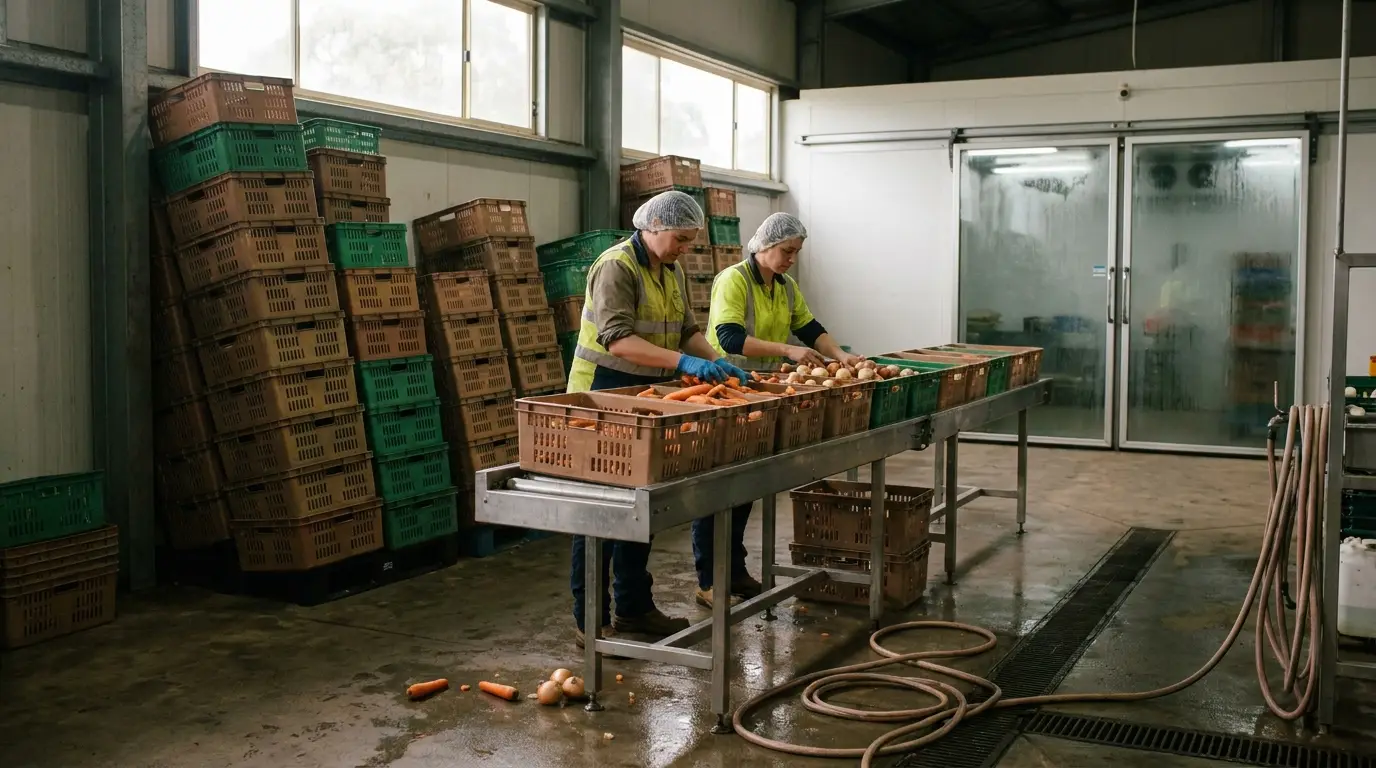
Most packhouses choose grading-line crates on colour and price, then spend years paying for the specs they ignored. The numbers that actually decide a line's economics are the fold or nest ratio (what it costs to send empties home), drainage and surface finish (whether you pass a food-safety audit), and stack strength (whether the line keeps moving). This is a buyer's guide to the crate spec that sets throughput and return-freight cost on a grading line, with the numbers to decide by.
What makes a good grading-line crate?
A good grading-line crate is food-grade, drainable, dimensionally standard and cheap to send back empty. In practice that means a vented, smooth-walled PP or HDPE crate on the 600 × 400 mm module, in a height that suits your crop, that either folds flat or nests for the return leg. Colour, branding and handle style are real but secondary, they do not change your cost per trip; the fold ratio, the drainage and the stack strength do.
The reason it matters is money that leaks quietly. A crate that cannot be sanitised risks a failed audit and a lost supermarket program. A crate that ships back rigid doubles your empty-transport bill. A crate that does not tile on your pallet slows every stack. None of these show up on the purchase order, so they get overlooked, which is exactly why they are worth specifying first.
Nest ratio and folded height: the return-freight number
On any two-way crate loop, the empty return leg is half your transport bill and it is the leg most buyers never cost. This is where fold and nest ratio earn their keep. A folding crate collapses flat when empty: a common 600 × 400 line crate stands 115 mm erected and folds to just 28 mm, a fold ratio of about 4:1. A rigid stackable crate cannot do this, empty, it takes exactly as much truck space as it does full.
The table below works the return leg for a single 1150 mm column of crate height (a typical stack on a return pallet), using real crate dimensions. The pattern is the point: folding crates send far more empties home per trip.
| Crate style | Erected height | Empty-return height | Crates per 1150 mm column (return) |
|---|---|---|---|
| Rigid stackable vented (e.g. BPB-6418U) | 180 mm | 180 mm (no reduction) | ~6 |
| Folding vented (BPB-P6411FV), erected | 115 mm | — | ~10 |
| Folding vented (BPB-P6411FV), folded | 115 mm | 28 mm (folds flat) | ~41 |
Read the last row against the first: a return column holds roughly 41 folded crates versus about 6 rigid ones, close to a 6× difference in empties per truck, before you count the labour of handling them. That is the case for folding crates in one number. As John Meir, our sales lead, puts it: "Growers price the crate; the smart ones price the empty trip home. On a two-way loop that folded height is where the freight budget is won or lost." The trade-off, folding crates versus rigid strength, is compared in stackable, nestable or folding crates, and the same freight maths for bulk bins is in collapsible vs fixed bulk bins.
Hygiene: drainage, smooth surfaces and wash-down
A grading-line crate is a food-contact surface, and that reframes the spec. It needs to be food-grade PP or HDPE, vented for drainage so wash water and field moisture leave rather than pool, and smooth-walled with rounded internal corners so it can actually be cleaned. Timber cannot meet any of this: it is porous, it harbours moisture and bacteria in the grain, and it cannot be reliably sanitised, which is why food programs move off it.
The stakes are not abstract. The FAO estimates that around 14% of the world's food is lost between harvest and retail, with the Australia and New Zealand region at the lower end near 5–6% (FAO, State of Food and Agriculture 2019). Damaged, contaminated or poorly cooled produce feeds directly into that figure, and rough or unsanitisable handling makes it worse. A drainable, sanitisable crate protects both the crop and the audit: the wash regime that keeps it compliant is set out in our hot-wash and sanitation SOP for produce bins, and the polymer and HACCP detail in food-grade plastic (HDPE, PP & HACCP).
Throughput and the 600 × 400 module
Throughput on a grading line is a standardisation problem before it is a speed problem. The 600 × 400 mm module (defined in ISO 3394) is the reason to standardise: it is a clean subdivision of the 1200 × 800 and 1200 × 1000 pallet bases, so it tiles without wasted space, four crates to a Euro layer, five to an ISO layer. That means predictable pallet stacks, dolly loads that do not overhang, and crates that feed a bin-tipper or conveyor at a known width every time.
Mixing footprints is where lines lose time: a stray crate size fouls the stack pattern, jams a tipper cradle or forces a manual re-orient. Keeping the whole line on one module, and matching that module to your pallet footprint, removes a class of small stoppages that add up across a shift. If your pallets are the square Australian 1165 (which does not tile 600 × 400 as neatly), it is worth reading the two decisions together in CHEP vs Euro vs Australian pallet sizes.
Stack strength and cross-stacking on the line
The last spec is what happens when crates sit on top of each other, full, on a moving line and in a cool room. A grading-line crate needs enough stack strength to carry the loaded crates above it without bowing into the produce below, and many line crates offer cross-stacking (rotate 90° to lock a stable column) as well as straight stacking. Bowed walls are not just a strength issue, they crush fruit and unsettle a stack that a forklift then has to move.
Match the height to the crop and the drop. Shallow crates (around 115 mm) suit soft, bruise-prone lines where you do not want deep fill; deeper crates (180 mm and up) suit robust root veg and higher volume per handling. Whatever the height, keep the footprint constant so the stack stays square. For crops that then go into bulk storage rather than crates, the bin-side of the decision is covered in vented vs solid bulk bins, and the loss it prevents in how bin choice cuts post-harvest loss.
How to spec crates for your grading line
Spec to four facts. 1) Crop: soft/bruise-prone points to shallow, smooth crates; robust root veg allows deeper fill. 2) Wash regime: if crates are washed between uses, insist on food-grade PP/HDPE, full venting and rounded internal corners. 3) Return logistics: if crates come back empty, folding beats rigid on freight by roughly 4:1; if they stay on-site, rigid stackable is simpler and stronger. 4) Footprint: standardise on the 600 × 400 module and match it to your pallet and dolly base.
Get those four right and load rating, colour and handle style fall out easily. Browse the full plastic crate range across heights and styles, see how they fit the wider produce line on the fresh-produce hub or the catalogue, or send your crop, wash regime and return-leg details for a spec-backed quote.
Common questions
What size crate do packhouses use on a grading line?
The dominant footprint is the 600 × 400 mm module, in a range of heights (roughly 115–260 mm) to suit the crop and the line. The footprint matters more than the height: 600 × 400 mm is half a 1200 × 800 base and tiles cleanly onto pallets, dollies and conveyors (ISO 3394), so standardising on it keeps your whole line interchangeable.
Folding, nestable or stackable crates for a grading line, which is best?
It depends on whether crates return empty. If they do, folding (collapsible) crates win decisively, they fold flat for the return leg, cutting empty-transport volume by around 4:1 versus their own erected height. Rigid stackable crates are simpler and stronger for a fixed on-site loop; nestable crates sit between the two. Match the choice to your return logistics, not to habit.
Are plastic crates food-safe for fresh produce?
Food-grade polypropylene (PP) and HDPE crates are made for direct food contact and, unlike timber, present a non-porous surface that can be washed and sanitised between uses. That is what lets them meet food-safety expectations under FSANZ and pass a HARPS or Freshcare audit. The detail, materials, wash regimes and where each polymer suits, is in our guide to food-grade plastic (HDPE, PP & HACCP).
How do I cut return-freight cost on empty crates?
Use folding (collapsible) crates and count the return leg, not just the outbound. A crate that folds from 115 mm to 28 mm lets a return truck carry roughly four times as many empties per column of height as the same crate shipped rigid, and far more than a taller rigid crate. On a two-way loop that difference compounds every single trip.
How many 600 × 400 crates fit on a pallet?
Because 600 × 400 mm is a module, it tiles cleanly: four to a layer on a Euro 1200 × 800 base and five to a layer on an ISO 1200 × 1000 base. On the square Australian 1165 × 1165 pallet it does not tile as neatly, one of several reasons to think about your pallet footprint and crate module together rather than separately.
Sources: post-harvest food loss (~14% globally, harvest to retail; Australia & New Zealand ~5–6%), FAO, The State of Food and Agriculture 2019 (fao.org); packaging module 600 × 400 mm and its relationship to the 1200 × 800 / 1200 × 1000 base, ISO 3394; food-contact and food-safety expectations, FSANZ Standard 3.2.2 and Codex/HACCP hygiene principles (paraphrased, not quoted). Crate dimensions, folded heights, volumes and weights are the manufacturer's figures for the specific crate models referenced and vary by model. Return-freight and crates-per-column figures are single-column planning estimates from those dimensions and vary with pallet height, load and handling. Guidance is general and illustrative, not a price quote; confirm against your own line and a spec-backed quote. Not a quote.