
How bin choice cuts post-harvest loss on Australian farms

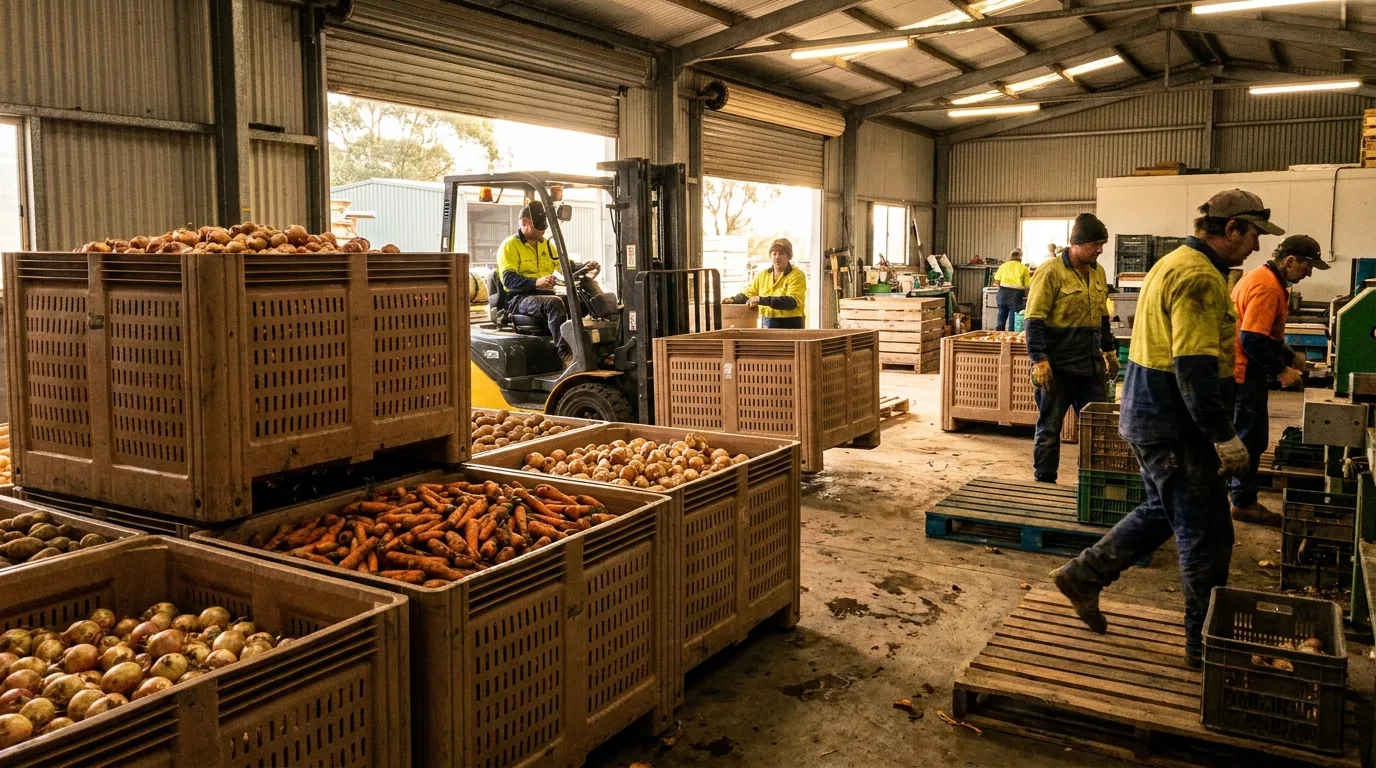
Most post-harvest loss is designed in before the crop ever reaches the cool room, in the bin it was picked into. The FAO estimates around 14% of the world's food is lost between harvest and retail (fao.org), and harvesting and on-farm storage are the most common loss points, exactly where the bin does its work. Four levers, venting, smooth internals, fill height and stacking, decide how much of your crop survives the trip from paddock to pack. This guide works through each one.
Does bin choice really change post-harvest loss?
Yes, and more than most growers credit. The bin is not just a box to move a crop in, it sets the temperature the produce cools at, the moisture it sits in, and how much mechanical damage it takes on the way. Get those wrong and you lose grade before the produce is ever assessed; get them right and you protect the pack-out without spending a cent more on the crop itself. The levers are simple and physical: airflow, surface finish, how much you put in, and how the bins sit together in the stack.
The trade-off worth stating plainly is that no single bin is right for every crop. A high-respiration crop that carries field heat wants maximum vent area; a delicate crop wants the smoothest internals; a dense crop wants the base rating to match. What does not change is the principle: match the bin to the crop and its cool chain, and the loss number falls.
How much produce is lost after harvest?
Globally, the FAO puts food lost between harvest and the retail shelf at around 14%, a figure worth roughly US$400 billion a year, and its analysis names harvesting and on-farm storage as the most frequent critical loss points across fruit, roots and tubers (fao.org). In Australia and New Zealand the regional figure is lower, a little over 5%, but that is a national average, not a floor you are guaranteed. On any given farm, a hot afternoon into solid bins, or a run of overfilled bins crushing their top layer, can push a single crop's loss far above the average in a day.
The useful thing about the FAO breakdown is where it points: not to the supermarket, but back up the chain to harvest, handling and storage. That is the grower's own ground, and the bin is the tool sitting in the middle of it. Every percentage point held back at this stage is grade that reaches the buyer instead of the tip.
How does bin venting slow spoilage?
A vented bin works on two problems at once: field heat and respiration. Freshly harvested produce is still alive and respiring, giving off heat, moisture and carbon dioxide. Trapped in a solid bin, that heat and moisture pool at the centre of the load, and the warm, humid core is where softening, mould and rot begin first. Open vents in the walls and base let cooling air pass through the whole stack, and let the moisture and heat escape rather than build.
This is why a vented bin only earns its keep when air is actually moving through it, in a cool room, under forced-air cooling, or in a well-ventilated store. The vent is a path for air; something still has to push cold air along that path. We work the airflow-and-stacking geometry through in vented vs solid bulk bins, and the crop-specific case for potatoes and onions in why potatoes and onions need vented bins. The short version: for any crop that respires and carries heat, vent area is not a nice-to-have, it is the difference between the core of the bin keeping and spoiling.
Which bin features stop bruising and damage?
Mechanical damage is the loss you can see, and the cheapest to design out. A bruise is a break in the flesh that invites rot and drops the grade, and most of it happens at three moments: the drop into the bin, contact with rough internal walls, and the tip-out at the wash line. The bin features that fight all three are smooth internal walls, rounded internal corners, and a consistent, gentle discharge. A one-piece moulded plastic bin has no protruding fasteners, splinters or broken boards to catch and cut produce, unlike a tired timber bin, which is a running source of bruising and contamination.
"The two mistakes I see most are the same two every season. Growers overfill, so the next bin down crushes the top layer, and they pack a heat-carrying crop into a solid bin because it was closest to the shed. Fix the fill line and match the venting to the crop and you get grade back for nothing."
John Meir, Sales Leader, 20+ years in plastic handling
Drop height matters as much as the surface. The higher produce falls into an empty bin, the harder it lands on the base and on the produce already there, so a bin that fills evenly and is not dropped from height protects the bottom of the load. For delicate and drop-sensitive crops the same principles run right through the harvest, from carrot and root-veg handling to the wash line.
How high should you fill a produce bin?
To the practical fill line, not to the brim. This is the single most common, and most avoidable, cause of in-bin loss. A bulk bin is engineered to carry the weight of the bins stacked above it through its own frame, walls and corners. Fill produce above the rim and the bin above no longer lands on that frame, it lands on your crop, crushing and bruising the top layer of every bin in the stack. The extra volume you gained by heaping the bin is lost several times over in damaged grade.
The right fill height is a balance between the crop's crush tolerance and the bin's stacking design, and it is why the bin's usable internal volume matters more than a heaped headline figure. If you are sizing a fleet by how much crop a bin actually holds safely, our produce bin sizing chart works through the internal-volume maths crop by crop. Fill to the line, let the bin carry the stack, and the top layer arrives as grade rather than juice.
Does stacking pattern affect crop loss?
It does, because stacking decides whether the venting you paid for actually does anything. Bins that stack square and true, with their vents lining up into continuous channels, let cold air run through the whole stack from bottom to top. Bins that sag, lean or sit crooked (the classic failure of old timber under load) pinch those channels shut, so the cold air short-circuits around the outside and never reaches the core of the middle bins. Consistent, dimensionally stable plastic bins hold their shape under a full stack for years, which keeps the airflow paths open.
The practical rule for a cool store is to stack so air can move vertically through the load, leave the aisle and wall gaps the cooling system needs, and avoid mixing bin heights that break the stack line. A vented bin, filled to the line and stacked square, is a cooling system component. The same bin dumped full and stacked crooked is just an insulated box.
How do I spec a low-loss produce bin?
Spec to four facts, crop weight, vent area, internal finish and whether it stacks square, then protect the cool chain around it. Start with the loaded weight of your densest crop and confirm the bin's base and racking ratings carry it with margin, so the base never bows under a full load. Match the vent area to how much the crop respires and how much field heat it carries. Choose smooth internals and rounded corners for anything that bruises. And confirm the bins stack square and stable so the airflow channels stay open through the whole store.
From there the wins compound. A food-grade plastic bin also washes down hard between crops, so you are not carrying rot spores or soil from one harvest into the next, the discipline is in our hot-wash and sanitation SOP for produce bins, and the curing case for storage crops runs through curing and storing onions. Browse the vented range across the fresh-produce range and the full IBCs and bulk containers, or send your crop, bin count and cool-chain setup for a spec-backed quote.
Common questions
Do vented bins really reduce post-harvest loss?
Yes, where the crop respires and carries field heat. Venting lets forced-air or room cooling reach the middle of the load and lets respiration moisture escape, so the produce at the core of the bin cools at close to the same rate as the produce at the edge. In a solid bin the centre stays warm and damp, and that is where rot, sprouting and softening start first. For low-respiration or dusty crops a solid bin can still be the right call, the point is to match the vent area to the crop.
How much food is lost after harvest?
The FAO estimates that around 14% of the world's food is lost between harvest and retail, worth roughly US$400 billion a year, with harvesting and on-farm storage the most frequent critical loss points (fao.org). The figure is lower in Australia and New Zealand, a little over 5%, but on a single farm a run of bruised or heat-stressed bins still translates straight into downgraded grade and rejected loads.
Why does overfilling a produce bin cause loss?
Because the bin stacked on top lands on the crop, not on the bin walls. Every bulk bin is designed to carry the load of the bins above it through its own frame and corners. Fill above the rim and that stacking weight bears down on the top layer of produce instead, crushing and bruising it. Fill to the practical fill line, not to the brim, and let the bin carry the stack.
Does bruising in the bin actually cost money?
Yes, directly. A bruise is a break in the skin or flesh that invites rot and drops the pack-out grade, so bruised units are either downgraded to a cheaper line or thrown. Smooth internal walls, rounded corners, a gentle tip-out and a sensible drop height all cut the mechanical damage that happens between the tree or ground and the wash line. It is one of the cheapest losses to design out.
Which is more important, the bin or the cool chain?
They work together. A vented bin only helps if cold air is actually moving through the stack, and the best cool room cannot rescue produce packed into a solid bin that traps heat. Get both right: a vented bin, filled correctly and stacked square so air can pass, sitting in a cool store or under forced-air cooling that runs soon after harvest.
Sources: post-harvest food loss share and critical loss points, FAO, The State of Food and Agriculture 2019 (fao.org); regional loss estimates for Australia and New Zealand, FAO SOFA 2019. Product figures are manufacturer-tested load ratings and stated capacities for the specific bin models referenced and vary with crop density, load distribution and stacking. Loss percentages are FAO estimates for illustration; on-farm outcomes vary with crop, climate and handling. Not a quote.