
CHEP vs Euro vs Australian pallet sizes: which footprint fits your lane

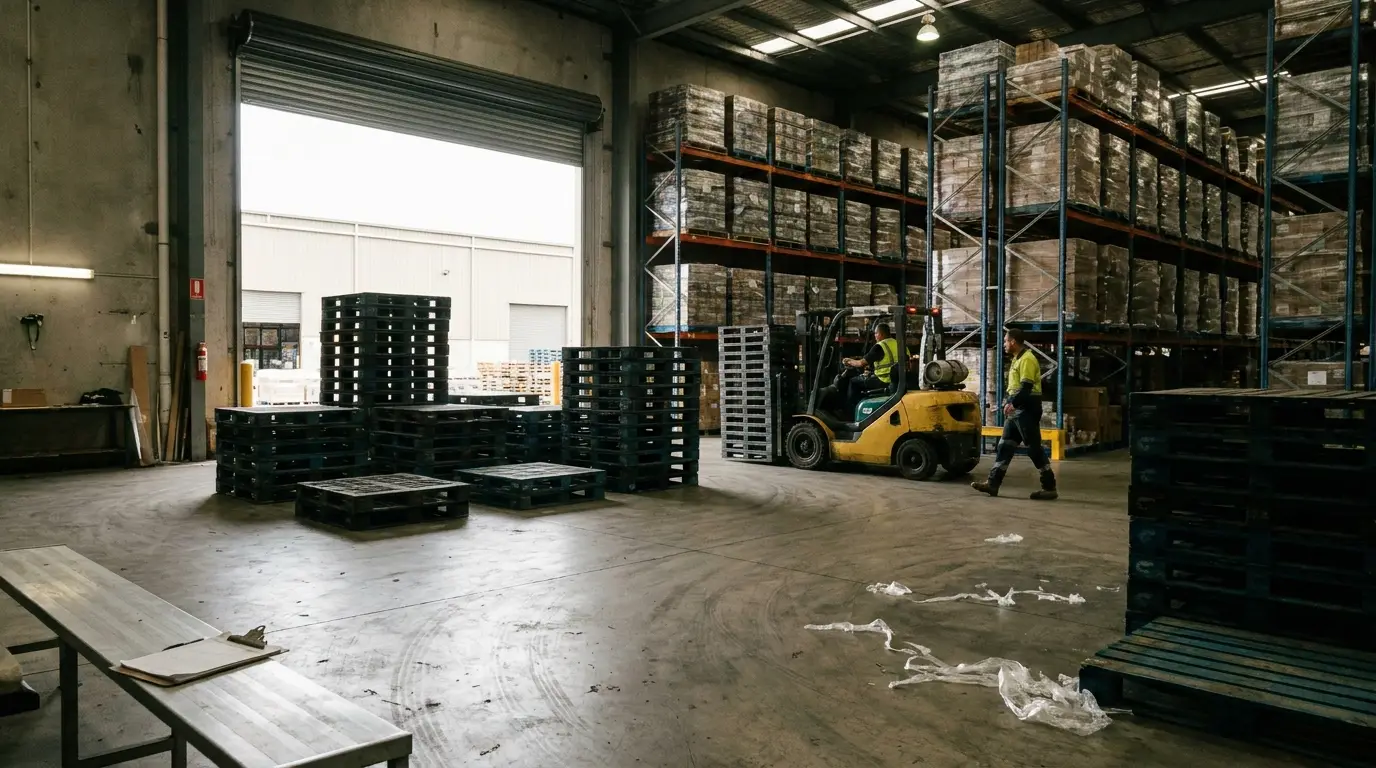
The pallet footprint you run is usually one you inherited, from a first customer, a pooling contract or whatever the last supplier shipped, and it quietly sets your container fill, your racking layout and your export cost for years. This is a plain comparison of the three sizes Australian operators actually meet, the CHEP/Australian 1165 × 1165 mm square, the Euro 1200 × 800 mm and the international ISO 1200 × 1000 mm, so you can choose the footprint on purpose rather than by accident.
CHEP, Euro or Australian pallet: which size should you run?
Run the square 1165 × 1165 mm pallet if your goods live on Australian rail, road and racking; run the 1200 × 1000 mm ISO footprint (or 1100 × 1100 mm) if you containerise for export. The decision is not really about the pallet, it is about your lane. The Australian square is excellent domestically and poor in a sea container; the rectangular Euro and ISO footprints are the reverse. "CHEP" confuses this because people use it as a size when it is actually a pooling brand, its blue Australian pallet is simply the 1165 mm square under a hire model.
Everything else, load rating, material, deck type, is a second-order choice you make after the footprint. Get the footprint wrong and no load rating saves you: you will either waste container space every shipment or repalletise at the border. So the rest of this guide puts the four footprints side by side, explains the quirks of the Australian square, and gives you a worked container-fill table to decide with.
The footprints you will actually meet in Australia
Four footprints cover almost every pallet that moves through an Australian warehouse. All except the local square are recognised in ISO 6780 (Flat pallets for intercontinental materials handling), which lists six standard sizes worldwide, and the Australian 1165 mm square sits among them too.
- Australian 1165 × 1165 mm (AS 4068) — the square that defines the domestic market; CHEP's blue AU pallet uses it. Loads and retrieves from any side.
- Euro 1200 × 800 mm — the European retail and food-logistics standard (EPAL); built around the 600 × 400 mm module.
- ISO 1200 × 1000 mm — the international/containerised footprint, the one a 2002 review found Australia would save billions by adopting.
- North American 1219 × 1016 mm (48 × 40 in, GMA) — the dominant US grocery footprint; you meet it on imported goods.
The one that trips people up is the local square, because its strengths and weaknesses are the exact opposite of the rectangular footprints. It is worth understanding why it is 1165 mm before you decide whether to keep running it.
Why is the Australian pallet 1165 × 1165 mm?
The Australian square is a metric survivor of an imperial decision. It began as a 46 × 46 inch pallet (from a nominal 48 × 48 in) and was later metricated to the marginally smaller 1165 × 1165 mm now set by AS 4068. Crucially, it was sized for the Australian rail network's RACE containers, where two pallets sit side by side and stack two high, giving a tidy 60 pallets across a wagon's three containers (Australian standard pallet, Wikipedia). Squared to the local transport system, it is genuinely efficient at home.
The square shape also earns its keep in a warehouse: because it is the same in both directions, it can be picked up, racked and turned from any face, which simplifies handling and racking layout. The full history of the dimension, and why it matches local racking so well, is worked through in our companion piece on why the Australian pallet is 1165 × 1165 mm. The catch only appears when the pallet leaves the country.
How many pallets fit a shipping container? (worked table)
Container space is the dearest space in most supply chains, so footprint efficiency shows up fastest here. The table below is a single-layer floor-fit planning guide from the nominal internal dimensions of standard general-purpose ISO containers (about 5.90 m × 2.35 m for a 20 ft and 12.03 m × 2.35 m for a 40 ft). It shows the shape of the difference, not a loading guarantee; mixed-orientation ('pinwheel') patterns and double-stacking lift the real counts.
| Footprint | Per 20 ft (single layer) | Per 40 ft (single layer) | Container fit |
|---|---|---|---|
| AU square 1165 × 1165 | ~10 (very tight) | ~20 (very tight) | Two across leaves ~10 mm total clearance, slow, awkward load; often repalletised |
| Euro 1200 × 800 | up to 11 | up to 24–25 | Strong; designed around container and truck widths |
| ISO 1200 × 1000 | ~10 | ~20–21 | The international container footprint; clean, workable clearance |
| Alt export 1100 × 1100 | ~10 | ~20 | Two across with ~150 mm clearance, the common export swap from 1165 |
The headline is the clearance, not the count. Geometrically the 1165 square nearly matches the ISO footprint's count, but ~10 mm of total width clearance makes it a genuinely difficult container load, which is why the size is formally described as ill-suited to sea containers and why exporters commonly drop to 1100 × 1100 mm for the workable gap. As John Meir, our sales lead, puts it: "On a domestic rail lane the square is the right answer; the moment it goes in a sea can, you're paying for those missing millimetres in labour, damage or a repalletise at the wharf."
Which footprint fits your racking?
Racking is where the square footprint pays you back. Australian selective racking is typically set up for the 1165 mm pallet, and because the pallet is square it can be loaded and retrieved from either face without re-orienting, which speeds a forklift operator and reduces mis-picks. A rectangular Euro or ISO pallet is directional: it has a "long" and a "short" way into the beams, and getting it wrong wastes a bay or fouls the flue space.
Whatever the footprint, the number that keeps a rack standing is the racking load rating, not the flattering static figure, and it must be confirmed at your actual beam span. A pallet rated, say, 1,000 kg racking under a uniform load can be well under that with a concentrated or point load. We work the three ratings, static, dynamic and racking, and how to de-rate them, in plastic pallet load ratings. Pallet racking design and loading in Australia sits under AS 4084.
Domestic vs export: the footprint decision that costs the most
This is where footprint stops being a preference and starts being a budget line. Because the Australian square fits sea containers so poorly, export goods on it frequently have to be repalletised to suit the destination, sometimes twice along the chain. A 2002 Australian government review put a number on the national cost of persisting with the non-standard footprint: a net present value of around $2.5 billion in forgone efficiency from not moving to the ISO 1200 × 1000 size (Australian standard pallet, Wikipedia). At an operation's scale, that surfaces as wasted container volume, double-handling labour and damage from re-stacking.
The practical rule: match the pallet to the lane, not the habit. If a product ships in a sea container, spec the ISO 1200 × 1000 (or 1100 × 1100) footprint from the packing bench so it never needs repalletising. If it stays on Australian rail, road and racking, the 1165 square is the efficient choice and a plastic version removes the ISPM-15 treatment and pest issues of timber, covered in plastic vs timber export pallets. Where you run a pooled fleet, weigh the pool's footprint against your lane too, we compare the models in pooling vs buying plastic pallets.
How to choose a footprint for your operation
Decide in this order. 1) Lane: domestic-only points to 1165; any containerised export points to 1200 × 1000 or 1100 × 1100. 2) Racking: confirm your beam spans and whether they are set for a square or a rectangular pallet, and size to the racking rating at that span. 3) Handling: square pallets suit multi-directional racking and turning; rectangular pallets suit directional flow and the 600 × 400 module. 4) Material and duty: only then choose load rating, deck type and plastic vs timber.
If you run mixed lanes, it is often cheaper to standardise the packing module (600 × 400 mm cartons and crates) and keep two pallet footprints, one for domestic, one for export, than to force one footprint to do both jobs badly. Browse the full plastic pallet range across footprints, see how they serve each vertical on the mining and fresh-produce hubs or the wider catalogue, or send your lane, racking type and freight postcode for a spec-backed quote.
Common questions
Is the CHEP pallet the same as the Australian standard pallet?
In Australia, yes, on size. CHEP's blue Australian pallet uses the 1165 × 1165 mm Australian Standard footprint (AS 4068). CHEP is a pooling brand, not a pallet size, it hires the pallet and manages the pool, but the footprint is the same square that defines the local market. Euro (1200 × 800 mm) and ISO (1200 × 1000 mm) are different footprints entirely, and CHEP also pools those in their home regions.
What size is a Euro pallet?
A Euro pallet is 1200 × 800 mm, one of the six footprints listed in ISO 6780. It is the retail and food-logistics standard across Europe and is built around the 600 × 400 mm packaging module, four of which tile one Euro layer. It is rectangular, so it is directional in a rack and on a conveyor, unlike the square Australian pallet.
Why does the Australian pallet not fit shipping containers well?
Because it was never designed for them. The 1165 mm square was sized for Australian rail (RACE) containers and local trucks, where two sit neatly side by side. In a standard 20 ft or 40 ft ISO sea container (about 2.35 m internal width) two 1165 mm pallets leave only around 10 mm of total clearance, an impractically tight, slow load, which is why the size is described as ill-suited to ISO shipping containers and exporters often switch footprints.
Should I use 1165 or 1200 × 1000 for export?
For containerised export, the 1200 × 1000 mm ISO footprint (or 1100 × 1100 mm) almost always loads and clears a sea container better than the AU square, and avoids repalletising at the destination. Keep 1165 × 1165 for goods that stay on domestic rail, road and racking. If a line does both, decide by where the freight cost is heaviest, container space is usually dearer than a domestic pallet swap.
How many pallets fit in a 20 ft and 40 ft container?
As a single-layer planning guide from nominal internal dimensions: a 20 ft holds roughly 10 (1200 × 1000), up to 11 (Euro 1200 × 800), or a tight ~10 (AU 1165); a 40 ft holds roughly 20–21, up to 24–25, and ~20 respectively. Mixed-orientation ('pinwheel') loading and double-stacking change these, so treat them as a starting point, not a guarantee. See the worked table above.
Sources: pallet footprint standards, ISO 6780:2003 Flat pallets for intercontinental materials handling (iso.org); Australian Standard pallet footprint 1165 × 1165 mm, AS 4068 Flat pallets for materials handling (Standards Australia); origin of the 1165 mm size, RACE-container fit, "ill-suited" to ISO sea containers, repalletisation and the 2002 review's ~$2.5 billion NPV estimate, Australian standard pallet (en.wikipedia.org); packaging module 600 × 400 mm, ISO 3394; pallet racking design and loading, AS 4084. Container internal dimensions are the commonly published nominal figures for standard ISO 668 general-purpose 20 ft and 40 ft containers; container-fill counts are single-layer floor-fit planning estimates that vary with loading pattern and stacking. Load figures are the manufacturer-tested ratings for the specific pallet models referenced and vary with load distribution, beam span and temperature. Footprint and freight guidance is general and illustrative, not a price quote; confirm against your own lane and a spec-backed quote. Not a quote.