
How a Murray Valley grape grower standardised harvest handling on one deep folding vented crate
A Murray Valley wine-grape and table-grape grower.

The operator
This is a grape grower on the Murray Valley running a dual operation: table grapes for the fresh market and wine grapes hand-picked for short transfers to local wineries. Their harvest window is hot, fast and labour-heavy, and through it everything turns on how quickly picked fruit gets off the vine, into a crate, and cooled or transferred without sweating or crushing. They came to us with a crate problem that was costing them both labour and fruit condition during the vintage rush.
The problem with the old handling
Their harvest handling was a patchwork. Table-grape bunches went into a mix of borrowed bins and single-trip boxes, while wine fruit for the wineries travelled in whatever was to hand. Two costs flowed from that. The disposable boxes were a recurring spend that mounted across a big-volume harvest, and the mixed sizes meant constant sorting, de-nesting and handling friction on the line at exactly the time of year when labour is tightest and most expensive. Solid-sided containers also let warm fruit sweat in the back of a hot pick, downgrading bunches before they ever reached the cool room or the crusher.
Why this product
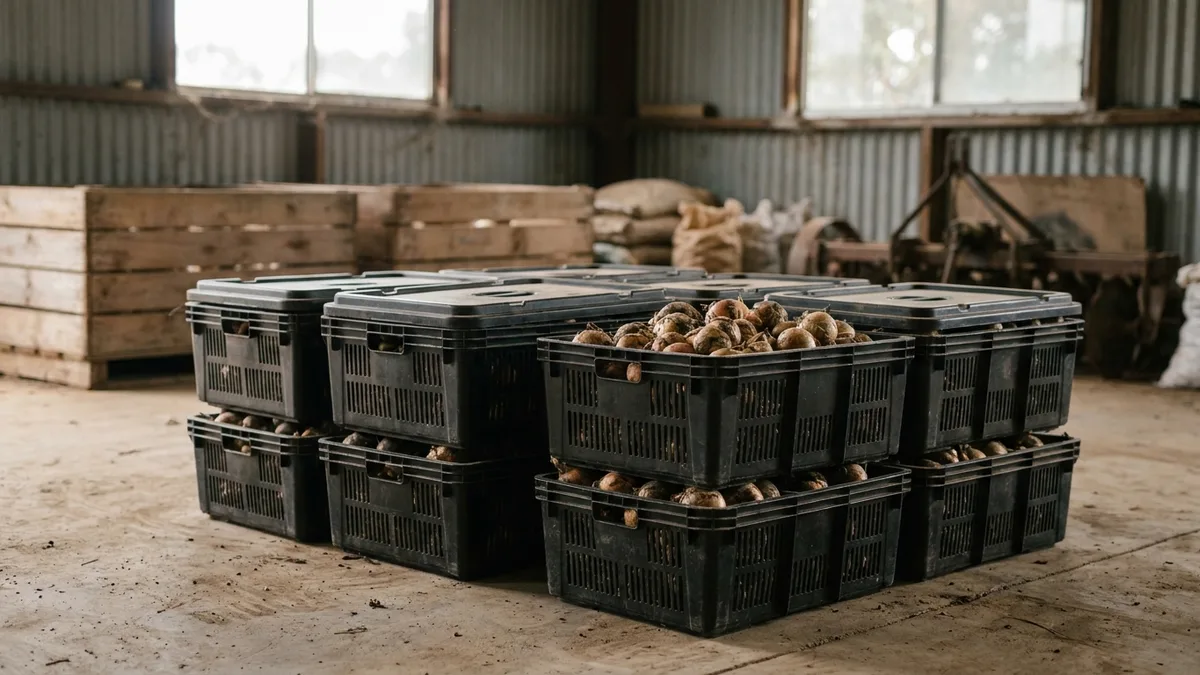
They standardised on the 46 L Folding Vented Plastic Crate (BPB-P6422FV): a 600 x 400 x 219 mm crate moulded from PP, with ergonomic lock handles, full venting, cross-stacking and a folded height of just 28 mm at only 1.87 kg empty. For a dual table-and-wine operation it does both jobs from one SKU. The 46 L deep body holds a useful hand-pick weight, so pickers fill fewer, fuller crates; the open venting prevents the fruit sweating during the warm vintage run and lets field heat escape; and the ergonomic lock handles speed packing and make the crates stable to cross-stack on a pallet. Critically, the crate folds to a 28 mm flat — so the empties that used to ride back from the block or the winery as rigid units now collapse to almost nothing for the return.
Standardising on the 600 x 400 ISO module also matched the returnable systems their fresh-market buyers and wineries already run, so the same crate carries fruit all the way through rather than being decanted. The large 3,750-unit MOQ reflects a crate bought by the harvest-scale fleet, which is exactly how a high-volume grower uses them.
The rollout
They rolled the crates in for the start of vintage across both table and wine picks. On the line the single standard size immediately removed the sorting and de-nesting friction of the old mixed boxes, and pickers liked the lock handles and the depth. In the field the venting did its job — fruit held condition far better through a hot pick than it had in solid boxes. After unload, crews fold the crates flat for the trip back, and the difference in return-load volume was obvious from the first run.
The estimated result
We frame these as estimates, because harvest labour and freight both swing with season and volume. On the line, standardising on one crate and retiring the mixed-box sorting, we estimate saving on the order of 2-3 labour hours per harvest day in handling and de-nesting at peak — meaningful when every hour of vintage labour is at a premium. On the empty-return leg, folding to 28 mm means crates collapse to almost nothing, and we estimate cutting the cost of freighting empties back to the block or winery by roughly 60-70% versus carting rigid units. Layer in the disposable-box spend the crate displaces and the fruit condition the venting protects, and we estimate the changeover pays back well within the early seasons of use, then keeps returning the labour and freight savings every vintage after.