
How a Coffs Harbour blueberry operation cut packaging spend and empty backhaul with a deep folding vented crate
A Coffs Harbour (NSW) blueberry grower-packer.

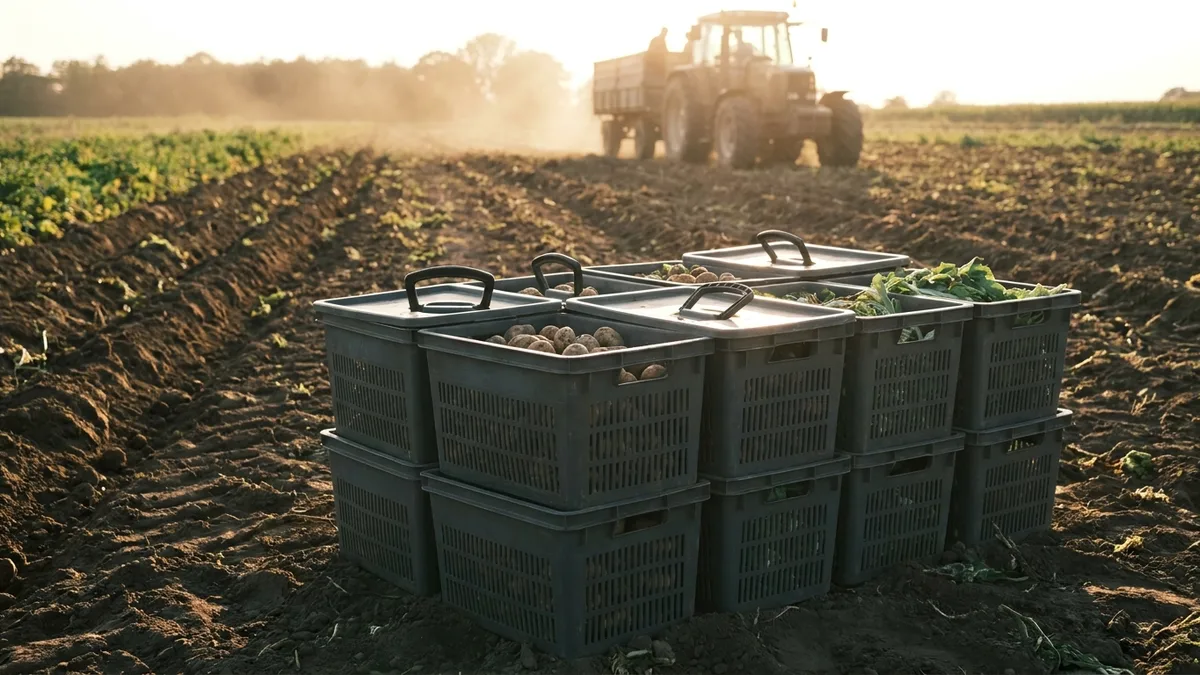
The operator
This is a blueberry growing and packing operation on the NSW mid-north coast around Coffs Harbour, supplying punnetised fruit into two state distribution centres on an ISO returnable-packaging loop. Berries are unforgiving in the cold chain — they need airflow to hold temperature and gentle, stable handling to avoid crush — and the operation needed crate depth without giving up either.
The problem with the previous setup
The operation had been shipping on single-trip cartons. Cartons are bought new every dispatch, then become someone else’s disposal problem at the DC; they offer limited venting, so punnets in the middle of a palletised load run warm; and they ride back as bulky rigid units if they come back at all. For a high-value, temperature-sensitive crop moving on an ISO loop, the recurring carton spend and the warm-load risk were both eating into margin.
Why this product
They moved to the folding vented plastic crate in the 41 L size (600×400×210 mm, PP, cross-stacking and stackable, built for ISO return-packaging systems). The depth carries a useful punnet load per crate while the fully vented walls keep cooling air moving through the fruit, so punnets hold temperature through the cold chain instead of the load centre running warm. It cross-stacks stably for palletised dispatch, and as a returnable on the existing ISO loop it replaces the single-trip cartons entirely rather than being binned at the far end.
The other decisive feature is that the crate folds flat. Erected for the outbound run, it collapses to roughly a fifth of erected volume for the trip back, so empties no longer ride home as bulky rigid boxes — they go back flat-packed, freeing trailer space for saleable fruit. The 41 L body and 600×400 footprint also drop straight onto the operation’s existing ISO loop without re-tooling the pallet pattern, so the crate slotted into the established returnable system rather than forcing a parallel one.
How the rollout went
The grower phased the crates in on the lane to its primary DC, where volume and cold-chain risk were highest, swapping out cartons line by line as the returnable pool built up. Pickers found the deeper crate took a clean punnet load, the cross-stack held the pallet square in the coolroom, and at the DC end the empties folded flat for backhaul. Because blueberries move fast and in volume through the picking season, even a small per-dispatch packaging saving compounds quickly across the run. With the loop proven on the first lane, the format extended to the second DC.
The result (estimated)
Moving off single-trip cartons onto a returnable crate removed the per-dispatch packaging buy, and we estimate that cut annual packaging outlay by an estimated 30% across the lines converted. On the return leg, with folded empties occupying roughly a fifth of erected volume, we estimate empty backhaul dropped by an estimated 70% — trailer space that now carries fruit rather than fresh air. The vented walls also held punnet temperature more consistently than cartons, which the operation expects to show up as fewer warm-load quality issues, though that varies with cold-chain discipline and ambient conditions. These figures are estimates only, dependent on volume, loop efficiency and crate service life, and do not constitute a price quote.