
A Bundaberg Sweet-Potato Washpack Ends the Double-Handle Into Cartons
A Bundaberg sweet-potato washpack in coastal Queensland.

The operation
This is a sweet-potato washpacking operation around Bundaberg in coastal Queensland, taking crop in from bulk field bins, washing and grading it, and dispatching retail-ready packs to supermarket distribution centres. Their throughput is high and their margin is thin, so every extra time a tuber is touched and every disposable carton bought eats directly into the return.
The problem with the old handling
The washpack was double-handling. Product came out of bulk bins, got washed, and was then hand-packed into flimsy single-use cartons for supermarket-ready dispatch. Two problems followed. The cartons couldn't really take the wash moisture still on the tubers, so boxes softened and crushed when cross-stacked on the pallet, damaging the layer below. And every carton was a purchase that went out the door once and never came back — a permanent consumable cost, plus the disposal of erected boxes at the DC end.
Why this crate
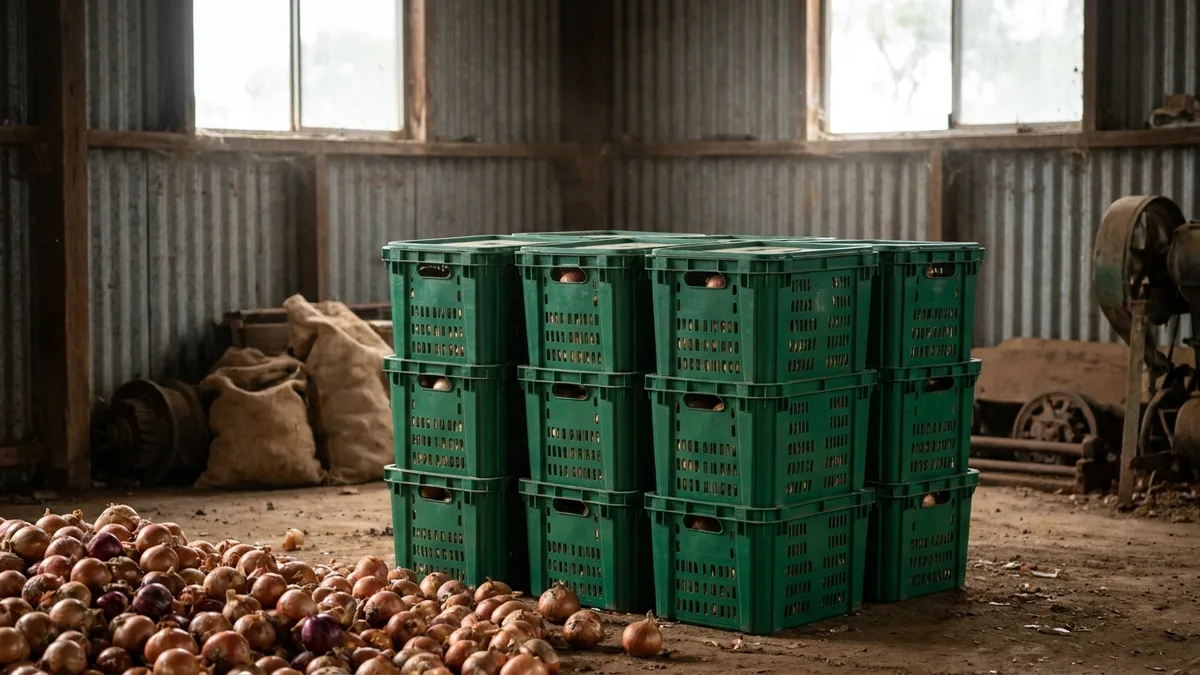
They made the BPB-P6416FV their standard retail-ready unit. It is a 600 x 400 x 160 mm folding vented crate, moulded from polypropylene, with a 32-litre capacity and an internal cavity of 570 x 370 x 153 mm. At just 1.62 kg each it's effortless to handle on a pack line, and it's built for ISO returnable-packaging systems, with both cross-stacking and stacking designed in.
The vented walls did two jobs. They let the residual wash moisture keep drying off the tubers in transit instead of trapping it, and — critically — the crate cross-stacks rigidly on the pallet without crushing the layer below, because it's carrying the load through its own structure rather than through a damp cardboard wall. The folding action meant that once the crate is empty at the DC it collapses to a fraction of erected height for the return trip, turning a one-way carton into a returnable that comes back flat.
The rollout
This crate carries a large minimum order (it's a mass-deployment returnable, MOQ in the thousands), so the washpack committed to it as a genuine pool rather than a trial — which suits a high-volume line where you want every dispatch on the same unit. They mapped the crate into their existing pallet pattern, confirmed the cross-stack held without box-collapse on a full pallet, and set up the empty-return flow with their DC so collapsed crates came back on the trucks that would otherwise run empty space.
The result — estimated
The carton saving is the clearest line, framed as an estimate. By replacing single-use boxes with a returnable crate on retail-ready lines, the washpack cut carton purchases by an estimated 25-35% in the first year as the pool displaced disposables — and that saving compounds every season the crates stay in rotation, because a crate amortises over dozens of trips while a carton is spent once.
The freight saving is the second effect. Because the crates fold to a fraction of erected height for backhaul, the empty-return freight bill dropped by an estimated 70% versus shipping rigid boxes back — collapsed crates simply take far less trailer space. There's a quieter quality gain too: ending the wash-moisture-into-cardboard problem removed the crushed-box damage that had been spoiling product on the bottom of the stack, and cut the double-handling of tipping out of bulk bins into boxes. We frame all of these as estimates — the exact percentages depend on trip counts and lane structure — but the pattern is a thinner consumable bill, far cheaper empty returns, and less damaged product.