
A Lockyer Valley produce grower cuts carton spend and return-leg freight with 23 L folding vented crates
A Lockyer Valley produce grower packing baby leaf and salad lines for Brisbane supermarket and wholesale programs..

The operator and the problem
A Lockyer Valley produce grower in south-east Queensland was cutting baby leaf, salad mix and bunched lines for supermarket and wholesale-market programs into Brisbane. Every dispatch left the shed in single-trip waxed cartons. The cartons did the job on the way out, but they trapped field heat against the leaf, sagged once the wash moisture hit them, and could not be sent back. The grower was paying twice: once to buy a fresh carton for every order, and again to landfill the spent ones at the distribution centre. On a crop that moves in high volume and downgrades fast when it warms up, both the packaging bill and the heat damage were eating margin the operation could not recover.
Why this crate
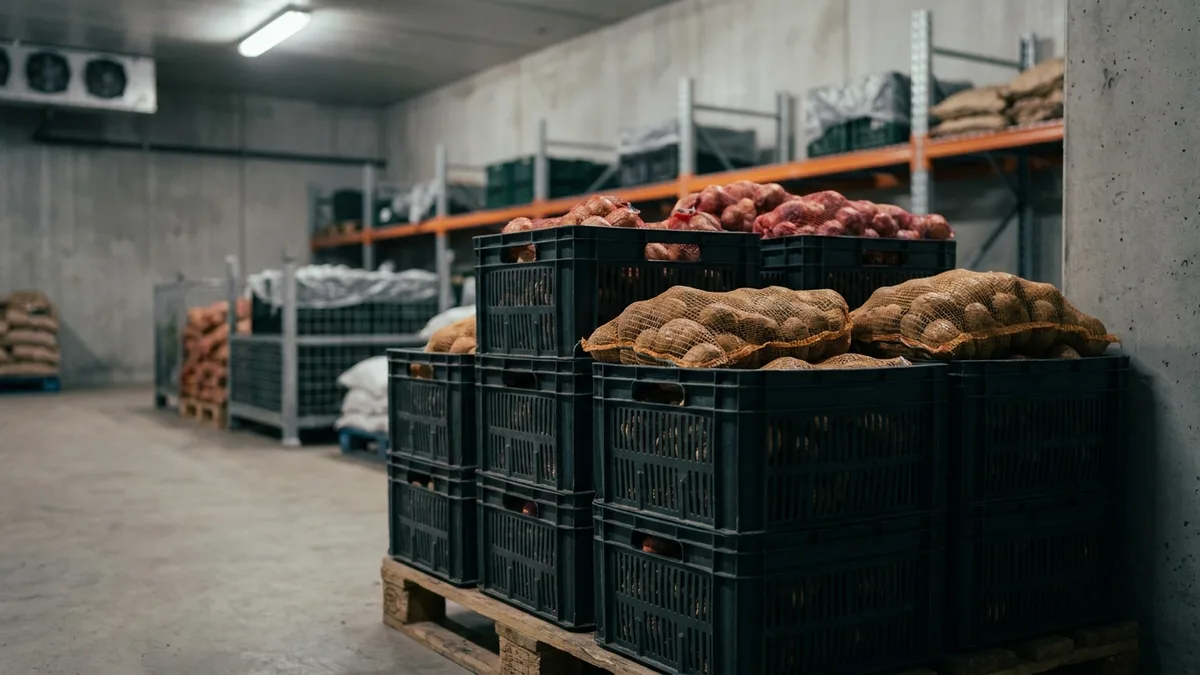
The BPB-P6411FV is a 600x400x115 mm folding vented crate moulded in polypropylene, holding 23 L with internal dimensions of 576x376x106 mm. Three things made it fit. First, the 600x400 mm footprint is a clean half of a standard 1200x1000 pallet, so four sit per layer with no wasted deck and the load squares up for stable palletised dispatch. Second, the vented walls let field heat and respiration air pass straight through the load, so baby spinach and salad mix hold temperature through pre-cooling and the cold chain instead of stewing in a sealed box. Third, and the reason it beat a rigid returnable, it folds. Erected it stands 115 mm; collapsed it drops to a 28 mm folded height, roughly a quarter of its standing height, so the empties ride home flat rather than as freighted air. At 1.48 kg each the crates are light to pack and de-nest by hand, and the ergonomic lock handles speed the line.
The rollout
The grower ordered against the 3,750-unit minimum, enough to seed a returnable pool that covers crates in the field, crates in transit and crates coming back empty without the loop ever running dry. They standardised the 600x400 footprint across the pack lines so every crate cross-stacks and stacks the same way, which removed the mixed-box sorting that had been slowing the bench. Field crews pack straight into vented crates in the paddock; full crates cross-stack onto pallets for the run to the DC; and on the return leg the empties fold to the 28 mm height and stack many-to-one for the backhaul. Because the crate is new-condition food-grade polypropylene, it wash-cycles cleanly between runs and meets the hygiene sign-off the supermarket program requires.
Industry fit
This is a produce crate first. For an agriculture and food-distribution operation moving leaf and bunched lines into supermarket DCs, the combination of full venting, a pallet-true 600x400 footprint and a flat fold is the exact spec the job wants: airflow to protect a heat-sensitive crop, a square load for palletising, and a collapsed empty that does not waste the return trip. The same crate suits any grower or distributor running short, high-frequency lanes where cartons would otherwise be bought and binned on every cycle.
Estimated result
Folded empties occupy in the order of a fifth of the truck space that erected crates do, so the grower estimates roughly 70% less freight on the empty return leg, which frees trailer space for saleable product coming the other way. Spread over an estimated 80-plus trips per crate, the cost per dispatch falls well below buying and dumping a single-use carton each time, and they expect the changeover to typically pay back within roughly a year against avoided carton and landfill spend. The vented walls are also expected to cut heat-related downgrades on the leaf versus the sealed cartons. These figures are planning estimates only; the real numbers depend on the operator's own dispatch volumes, crate cycle life and freight lanes.