
How a Gippsland leafy-vegetable grower kept lettuce crisp and cut return freight with a locking 32 L folding vented crate
A Gippsland (VIC) leafy-vegetable grower.

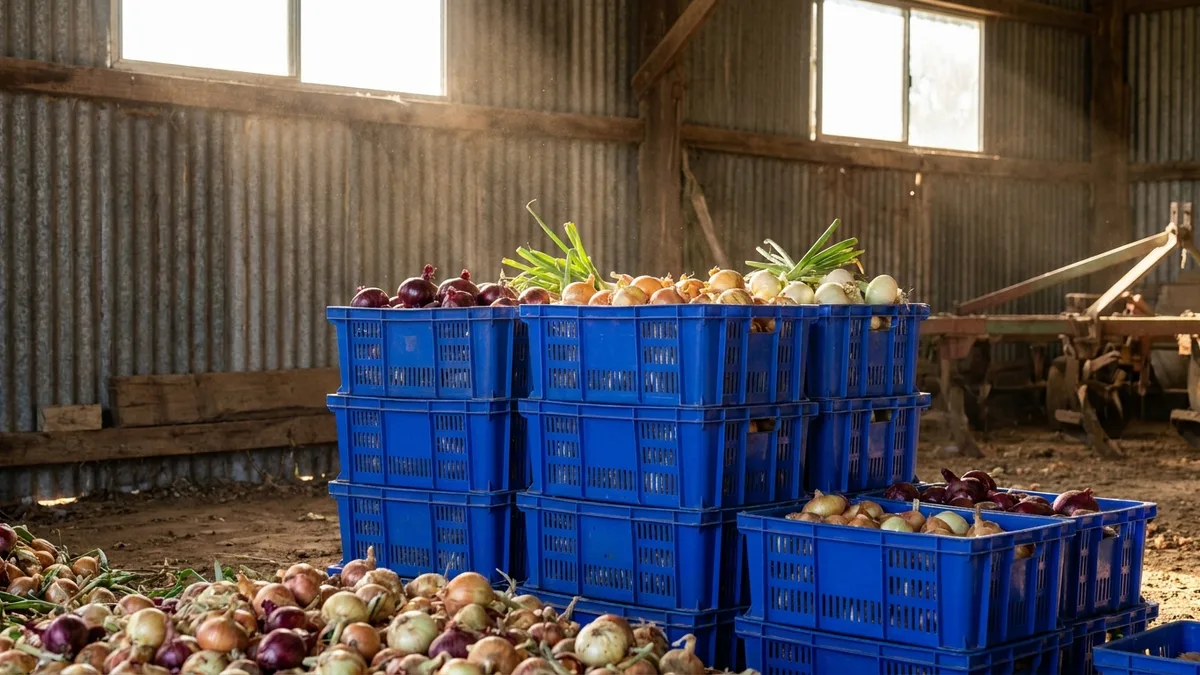
The operator
This is a leafy-vegetable grower in Victoria's Gippsland, cutting lettuce, silverbeet and similar lines for supermarket programmes and running them through a returnable-packaging distribution system to the retail DCs. Leafy crops are unforgiving: they wilt fast if field heat is not pulled out quickly, and they bruise if the crate stack shifts in transit. The grower asked us for a crate that locked together reliably through the distribution loop and vented hard, while bringing down the cost of moving empties back to the block.
The problem with the old handling
They had been packing into single-trip cartons. Cardboard holds heat against a respiring leafy crop, so cooling was slower than it should be, and damp boxes lose rigidity and let the stack settle and crush the layer below — exactly what you do not want over delicate lettuce. Every dispatch also bought new cartons and paid to dispose of them at the DC, and the rigid boxes that did come back travelled at full height, wasting return-leg trailer space. For a programme running steady volume, the packaging and freight lines added up quickly.
Why this product
They moved to the 32 L Folding Vented Plastic Crate (BPB-P5519FV): a 550 x 367 x 190 mm crate moulded from PP at just 1.63 kg, with advanced locking handles, strong wall venting and stackability, folding to a 31 mm flat. The crate is built for an Australian-Standard vegetable distribution loop. The advanced locking handles give a stable, interlocked stack that holds together through the cold chain instead of settling and crushing the crop. The strong venting pulls field heat out and keeps lettuce and silverbeet crisp through transit, which a closed carton simply cannot do. And it folds to a 31 mm flat, so empties collapse to a fraction of erected volume for the return run. The same crate also suits the occasional winery transfer, which fit a grower with a small mixed operation.
The rollout
They put the crate into the cutting line and onto the returnable loop with the DCs. The crew found the locking handles made for a noticeably more stable pallet than the cartons had managed, and the venting visibly helped hold condition on the leaf through the cold chain. De-nesting and re-boxing time dropped once a single crate size replaced the disposable cartons, and at season's end the empties folded flat for backhaul rather than riding back as rigid boxes.
The estimated result
We present these as estimates because packaging cost, labour and freight all move with volume and how tightly the loop is run. Replacing single-trip cartons with a returnable crate cuts packaging spend materially — we estimate on the order of 30% off annual packaging cost once the crate pool is established. Standardising on one locking crate also trims the handling lost to de-nesting and re-boxing, which we estimate saves roughly two labour hours per pack day. And the fold is the freight lever: collapsing to 31 mm means empties occupy a fraction of erected volume, which we estimate strips around two-thirds off the return-leg freight versus shipping rigid boxes back from the DC. Together those recover the changeover within a couple of seasons, then keep paying on every cycle.