
How a Tasmanian Potato Grower Stopped Losing Crop to Timber Bins
A Tasmanian potato grower in the northern midlands.

The operation
This is a mid-sized seed and table potato grower in Tasmania's northern midlands, lifting several thousand tonnes a season across a short, weather-pressured harvest window. Crop comes off the digger, gets carted to a central shed, cured, then held in store before grading and dispatch to mainland buyers. For years the entire flow ran on timber field bins.
The problem with the old handling
Timber bins looked cheap on paper, but the grower was quietly paying for them three times over. First, the boards absorbed soil moisture and held it against the crop, so the centre of a deep bin would sweat and rot before grading. Second, the timber itself failed periodic quality and biosecurity audits — damp, splintered, soil-caked boards are exactly what an auditor flags. Third, the bins were getting condemned and rebuilt every two to three seasons, so there was a permanent replacement line in the budget that never went away.
The grower had also started cross-loading bins onto the mainland for buyers who wanted product in store-ready containers, and shipping empty timber bins back at full height was burning trailer space they were paying for in both directions.
Why this container
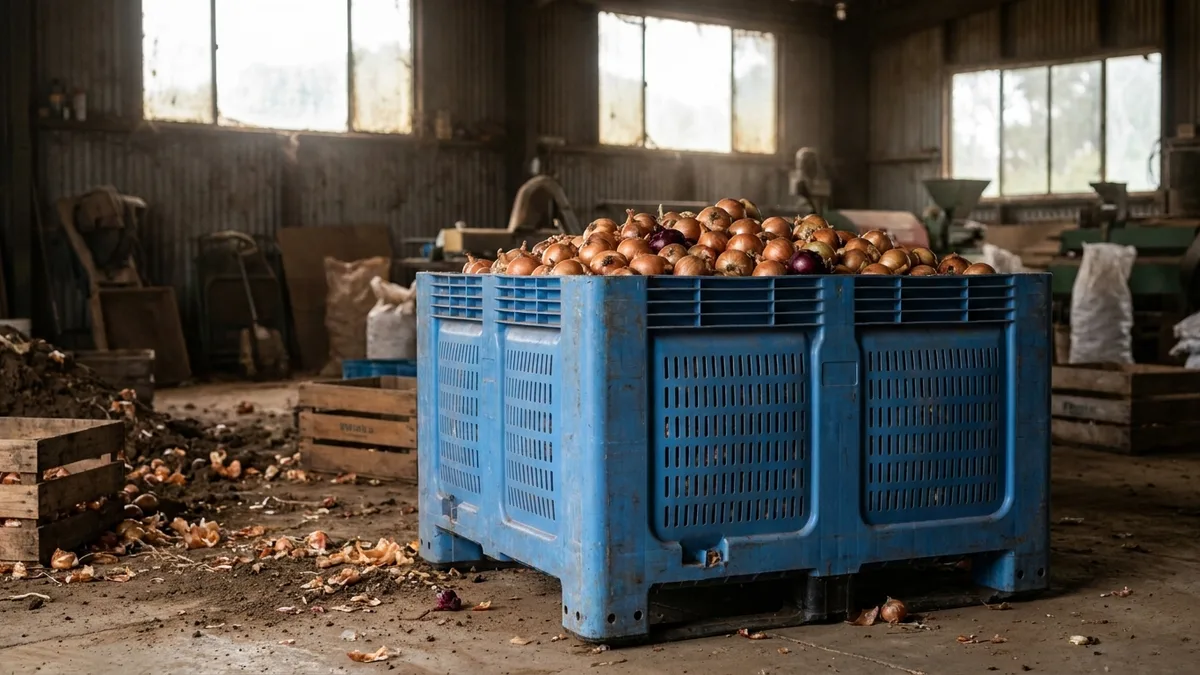
They standardised on the BPB-K1165V folding vented Australian-Standard pallet box. It is a 1162 x 1162 x 780 mm bin moulded from food-grade HDPE, rated to 3,000 kg static and 500 kg dynamic, with a 500 kg racking rating and a 750-litre body. Three things made it the right tool rather than just a plastic version of the timber bin it replaced.
The full-height venting was the headline. Vented walls let curing and respiration air move through the whole potato mass instead of trapping moisture against the boards, which is the exact failure they had with timber. At a bulk potato density around 650 kg per cubic metre, the 750-litre internal volume (1090 x 1080 x 635 mm) carries roughly 490 kg of crop per bin — a useful field load that still cures evenly because air can get to the middle.
The folding action was the second reason. The bin collapses to a 280 mm folded height, so empties returning from the mainland or sitting in the shed out of season stack about four-to-one against a rigid timber bin. The third reason was simply the HDPE itself: it hoses clean, doesn't absorb water, doesn't splinter, and presents an audit-friendly surface every single inspection.
The rollout
The grower did not rip-and-replace. They bought an initial tranche just above the minimum order of nine units, ran them through one full harvest-and-store cycle alongside the timber fleet, and watched how the vented crop held in store versus the timber-stored crop. Once the centre-of-bin rot stopped showing up at grading, they scaled the plastic fleet over the following two seasons and retired timber as it failed rather than writing it all off at once. The 2-way entry suited their existing forklift pattern in the shed, so no handling equipment changed.
The result — estimated
Two effects drove the payback, and both should be read as estimates rather than promises. On the empty-return leg, folding the bins to 280 mm gave roughly a four-to-one stacking gain over rigid timber, which we estimate trimmed something in the order of 4-5% off the freight cost of moving empties back from the mainland — every collapsed bin is trailer space that now carries saleable product instead of air.
The larger gain was shrink. Even a few percentage points of reduced store rot on a multi-thousand-tonne crop recovers more value in a single season than the bins cost. We'd frame it conservatively as a low-single-digit percentage shrink improvement on stored lines, which on this grower's volume comfortably outweighs the changeover outlay. Layer on the disappearance of the timber replacement budget — HDPE bins of this type routinely give a decade-plus of service against timber's two-to-three seasons — and the long-run replacement spend on bins falls by an estimated 50-70% over ten years. The audit non-conformances tied to wet, broken boards simply stopped being a line item.