
A recycling and beverage distributor runs a 1,040 L stackable folding IBC as a returnable
A national distributor handling non-hazardous liquid and recovered material on a bag-in-box system.

The operator and the problem
A national distributor handling non-hazardous liquids and recovered material across an active distribution network was buying one-way IBCs for each leg and losing both warehouse floor and return-truck space to rigid empties. With product moving in roughly 1,000 L lots through a network of sites, the empties piled up faster than they could be cleared, and the recurring single-trip container spend scaled directly with throughput. They needed a high-capacity container that could be stacked in the DC when full, to use the air space, and collapsed when empty, to stop paying to freight and store fresh air on the return leg.
Why this container
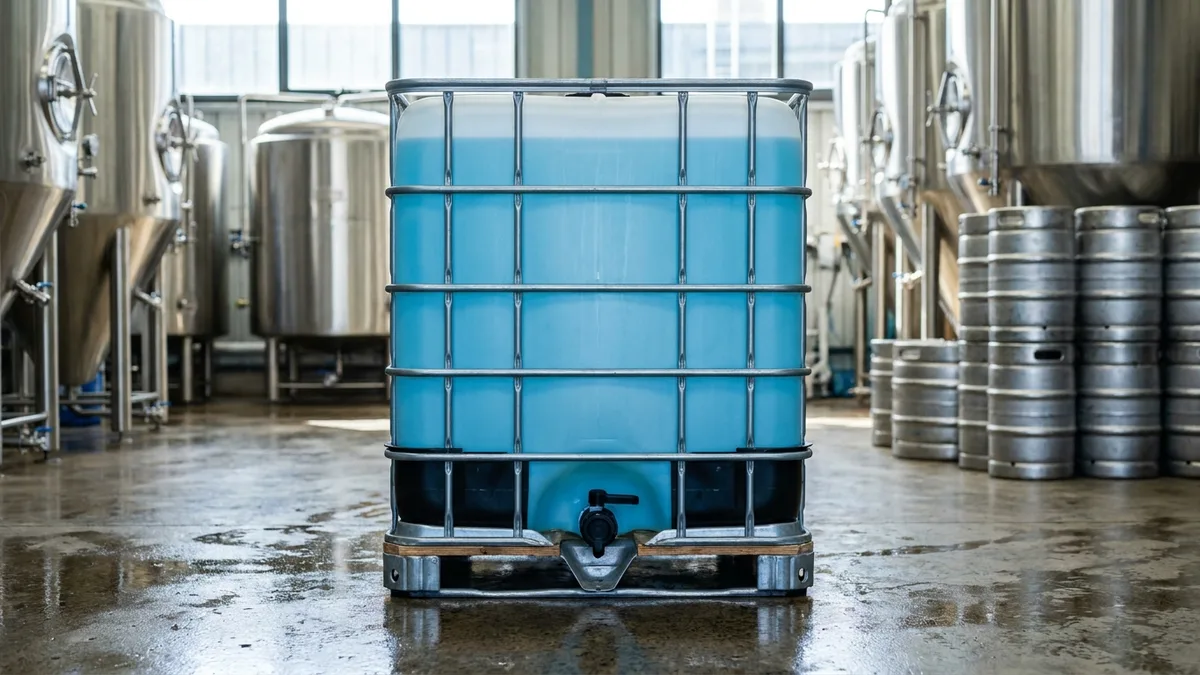
They adopted the BPB-H1210113FS, a double-wall folding solid bulk container on the 1200 x 1000 mm ISO footprint at 1130 mm high, giving 1,040 L of volume in polypropylene over a 1130 x 930 x 985 mm internal cavity. The double-wall construction earns a 7,500 kg static rating and a 1,400 kg dynamic rating, so a fully laden liquid load on a bag-in-box liner moves on the forklift and stacks securely in storage; the unit is rated stackable when erected, which let them build stable blocks in the DC rather than spreading single boxes across the floor. The solid walls suit the liner system and clean down between cycles, and the box folds to a 332 mm height for the empty return, so roughly three collapsed units occupy the footprint of one erected box. At 84 kg the shell is built to take the knocks of an active network for years.
The rollout
Run as a stackable returnable across the network, the container replaced the one-way IBC habit: erected and stacked at the filling and distribution points, then folded to 332 mm and returned three-to-one for refilling. The 9-feet base and 4-way entry kept handling fast at every node, and the double-wall body gave the operators confidence to stack full units where the old single-trip cages had been kept to a single layer for safety. The distributor ran the first cycles as a tracked pool to confirm the fold and the double-wall structure held up to repeated erect-collapse handling across multiple sites before scaling the fleet.
Industry fit
A stackable folding IBC suits an active distribution operation better than a rigid one because it earns its keep in both states: full and stacked it maximises cube in the DC and on the truck; empty and folded it minimises the cost of the return. For a business straddling beverage, food-distribution, recycling and 3PL flows, one 1,040 L double-wall shell that does both removes the need to choose between cube efficiency and return efficiency.
Estimated result
We estimate that running the H1210113FS as a stackable returnable rather than buying one-way IBCs cuts the empty-return volume to roughly a third (about three folded units in the space of one rigid box) while removing most of the recurring single-trip container purchase across the network. On a high-throughput loop a reusable IBC of this capacity generally recovers its cost against repeated disposable spend within about a year, and the stackable-when-full design also reclaims warehouse floor that rigid empties had been consuming. These are directional estimates dependent on cycle count, lane length and stacking discipline rather than a quoted figure, but the combination of high cube, a heavy static rating and a tight folded height is what made the closed loop viable at scale.