
A South Australian Onion Packer's Curing Bin That Drains and Stacks Deep
A South Australian onion packer in the Adelaide Plains / Mallee.

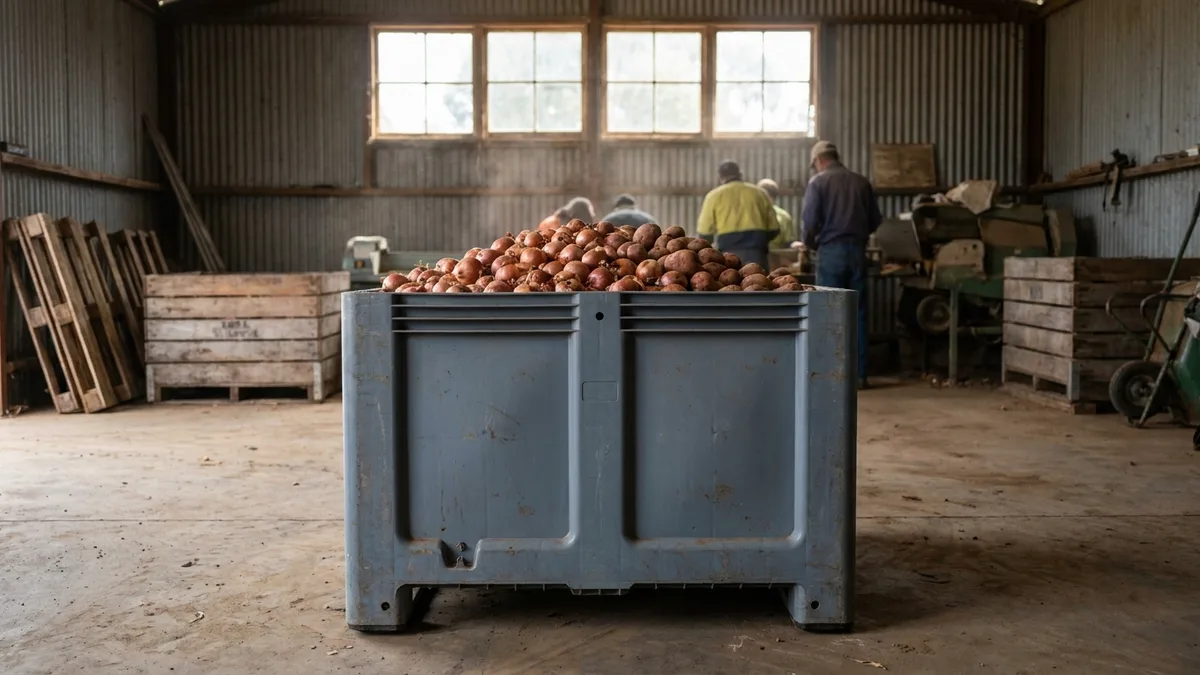
The operation
This is an onion grower-packer operating across the Adelaide Plains and Mallee in South Australia, curing and storing bulb onions before grading and dispatch to domestic retail and export. The crop comes in off the paddock needing to dry down and cure, then sits in deep store stacks for weeks before it moves. Two failures matter to them: bulbs that sweat in store, and bins that can't be stacked deep enough to use the shed properly.
The problem with the old handling
The packer needed a bin that did three jobs at once — carry curing air through the bulb mass, drain free moisture away from the onions, and stack densely enough in store to make the controlled-storage space pay. Their previous bins compromised on at least one. Solid or poorly vented bins trapped respiration heat and moisture against the bulbs, which drives rot and shrink in stored onions. And lighter bins couldn't take a deep store stack safely, so they were leaving vertical space unused in an expensive store.
Why this container
They adopted the BPB-D1210V74, described as the strongest vented ISO-standard bulk container available. It is a 1200 x 1000 mm bin at 740 mm tall, moulded from food-grade HDPE and PP, rated to a substantial 5,000 kg static and 1,000 kg dynamic, with a 605-litre body and 4-way forklift entry. The high static rating is the differentiator here: at 5,000 kg static it supports the deep store stacks the packer wanted, letting them use the full height of the store rather than capping the stack early for fear of crushing bins below.
The full-wall-and-floor venting carries curing and respiration heat away from the bulbs and lets condensation drain instead of pooling — the direct fix for the sweat-and-rot problem. The 4-way entry speeds handling during a busy intake, and the 1,000 kg dynamic rating means a forklift can move a fully loaded bin without drama. The HDPE/PP body takes daily handling and wash-down without absorbing moisture or harbouring the bacteria that timber does.
The rollout
This is a rigid bin with a minimum order around 106 units, so the packer brought it in as a fleet standard for the curing-and-store operation rather than a pilot. They filled the bins straight off the harvest, stacked them to the new, deeper height the 5,000 kg static rating allowed, and tracked stored-onion condition through the storage window against their previous bins. The drainage and venting showed up first — drier bulbs, less rot at the base of the stack.
The result — estimated
Two effects drive the value, both framed as estimates. The first is shrink: better airflow and free-water drainage through a vented bin reduces the rot and weight loss that stored onions suffer when moisture is trapped. Even a modest reduction in stored-onion shrink recovers significant value across a full store of crop, and we'd put it as a low-single-digit percentage improvement that comfortably exceeds the cost of the bins over a season or two.
The second is utilisation and longevity. The 5,000 kg static rating let the packer stack deeper and use store space they'd previously left empty, effectively getting more crop into the same controlled-storage footprint. And against timber bins on a two-to-three-season renewal, an HDPE/PP bin of this grade gives many times the service life — so we estimate the combination of reduced shrink and a far longer-lasting bin recovers the changeover cost within roughly two to three seasons. The numbers move with the crop and the season, but the mechanism is solid: drain it, vent it, and stack it deep.