
A South Australian winery standardises must handling on 500 L solid Euro bulk containers
A Barossa-region South Australian winery moving crushed fruit and must through vintage..

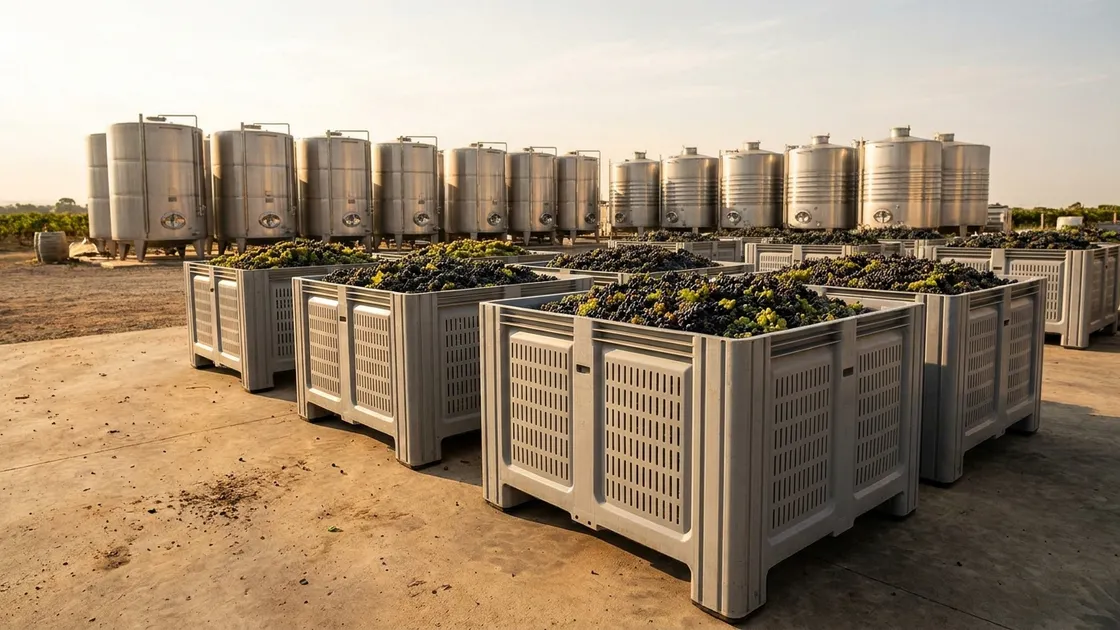
The operator and the problem
This operator is a mid-sized winery in South Australia's Barossa region, crushing fruit through a compressed six-week vintage and moving must, juice and pressings between the crush pad, the press hall and the fermentation floor. Their old fleet was a mix of timber-framed bins and ad-hoc tubs in inconsistent footprints. Nothing stacked squarely, nothing washed down cleanly, and at the height of vintage the yard manager was losing hours to bins that did not nest into the racking or sit true on the forks. Hygiene was the bigger worry: porous and damaged surfaces are hard to sanitise between batches, and in a winery cross-contamination between parcels is a quality risk, not just a housekeeping one. They wanted one repeatable unit they could buy in volume, wash, and trust.
Why this container
The Solid Euro Bulk Container (SKU BPB-D1208S74) fit the brief on footprint first. At 1200 x 800 x 740 mm it lands on the standard Euro footprint, so it lines up with existing pallet racking and truck beds instead of fighting them. Internally it carries 1120 x 720 x 600 mm of usable space and a rated 500 L volume, which is a sensible single-operator parcel of must rather than an unmanageable monolith. The solid walls and base are the point for a winery: a closed PP and HDPE body wipes and pressure-washes down cleanly between batches, with no vent slots to trap skins or lees. At 32 kg empty it is still manageable to reposition by hand when stacking is broken down. The static load rating of 4000 kg gives real confidence when these are stacked loaded on the floor, and the 700 kg dynamic rating comfortably covers a full parcel of crushed fruit being lifted and carried.
The rollout
We specified the container with 4-way forklift entry so the crush-pad operators and the press-hall crew can approach a bin from whichever side the aisle allows, which matters when the floor is wet and congested during vintage. The operator chose the three-skid bottom support as the middle ground between rigid floor stacking and pallet-jack access. Because the minimum order quantity is 90 units, they were able to standardise the whole vintage flow on a single identical bin in one purchase, rather than running a patchwork. We staged delivery ahead of crush so the team could pre-position empties at the pad. Identical footprints meant the wash-down bay, the racking and the forklift routine only had to be set up once.
Industry fit
Closed, hygienic bulk handling is exactly where a solid-walled container earns its keep. Food-grade PP and HDPE are inert, non-tainting and built for repeated sanitation cycles, which is why this same unit suits food distribution and pharmaceutical handling as readily as a winery. For wine specifically, the sealed body protects parcel integrity between fermentation batches and stands up to the acids and sugars of must far better than timber. The 500 L volume and the 4000 kg static rating make it a genuine workhorse on a fermentation floor where bins are stacked, moved and washed many times across a season and then stored flat-nested in the off-season.
Estimated result
On a fleet of roughly 90 identical bins, the operator expects the gains to come from standardisation rather than any single feature: faster wash-down on one repeatable unit, cleaner stacking on the Euro footprint, and far less time lost to mismatched bins during the vintage crunch. Against replacing damaged timber and tubs each season, a durable closed plastic bin that survives many cycles typically pays back in the order of a year or so. These are planning estimates only, and the real payback depends on the operator's own crush volumes, batch counts, wash-down labour and freight lanes.