
How a Barossa winery ended vintage cross-contamination and timber bin replacement with a super-strong solid bulk container
A Barossa Valley boutique winery.

The operator
This is a family-run boutique winery in South Australia's Barossa Valley, crushing a few hundred tonnes of fruit a year across shiraz, grenache and mataro. Through vintage they hand a lot of must, pressings and parcels of fruit between the crusher, the press and the ferment hall, and most of that movement happens in half-tonne bins on a forklift. They came to us at the end of a hard vintage because their bin fleet had become a hygiene liability and a recurring cost they could no longer ignore.
The problem with the old handling
Their must and pressings were being carried in timber half-tonne bins. Timber is the wrong material for a winery for three reasons, and they had hit all three. First, raw timber soaks up juice, wine and tannin, so the bins stained, smelled and could never be properly sanitised between batches — a genuine cross-contamination risk when you are running separate small parcels and trying to keep them clean. Second, the absorbed moisture and acid slowly rotted the timber, so a slice of the fleet had to be condemned and rebuilt every few vintages. Third, full timber bins are heavy and awkward, and a cracked board mid-vintage is a make-safe job at the worst possible time of year.
Why this product
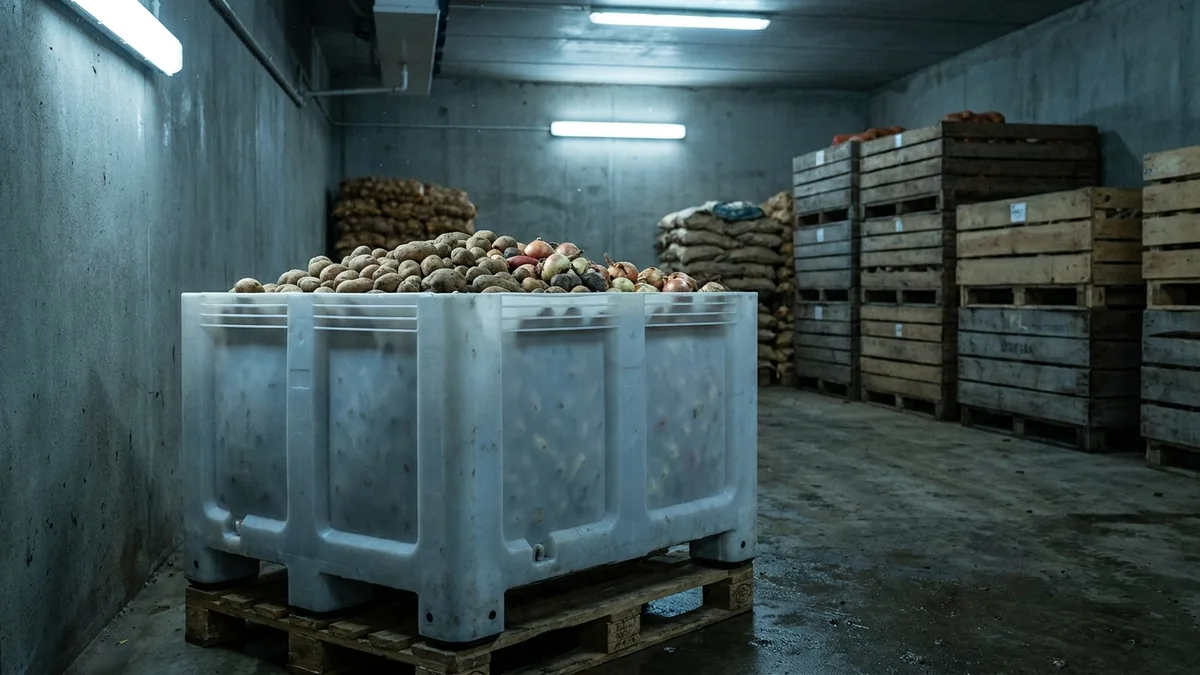
They switched to the Solid Plastic Bulk Container (BPB-D1120S78): an Australian-Standard 1120 x 1120 x 780 mm bin with a 700 L body, moulded from food-grade PP and HDPE, rated to 4,000 kg static and 700 kg dynamic, on a choice of two-skid, three-skid or nine-foot base. Everything about the spec answers the timber problem. The smooth solid walls wash and sanitise cleanly between batches, so a bin that held one parcel can be turned around for the next without carrying flavour, colour or bugs across. The food-grade HDPE shrugs off the acid and tannin staining that was destroying the timber, and at 40.5 kg empty it is far lighter to manhandle and reposition than a comparable timber bin. The 4,000 kg static rating means the bins stack safely full in the ferment hall, and the bottom-support options let them match the forklift entry they already run.
For a small winery the durability maths is the clincher. A timber bin renewed every few vintages is a permanent line in the budget; an HDPE bin that ignores acid and washes clean is a decade-plus asset. The 64-unit MOQ let them re-equip the whole must-handling fleet in one buy rather than running a mixed, half-rotten set.
The rollout
They brought the bins in ahead of crush and ran them straight into must and pressings handling. The immediate, obvious win was sanitation: a quick hot wash returned each bin to clean for the next parcel, which the cellar hands noticed within the first week because they were no longer fighting stained, sour-smelling timber. The bins stacked predictably in the hall, the forklift handled them on the skid base they specced, and there was simply nothing to rot or splinter as the vintage wore on. Out of season the bins wash down, dry and store without the slow decay that used to write off the timber over summer.
The estimated result
We frame these as estimates, because cleaning labour and replacement cycles vary with how hard a vintage runs. On replacement spend, swapping timber renewed every few vintages for HDPE rated for a decade-plus, we estimate a drop of roughly 50-60% in container replacement cost over a ten-year horizon. On top of that, the washable solid walls cut the cleaning and make-safe time that timber demanded, and — harder to price but real — they remove the cross-contamination risk of carrying one parcel's character into the next. For a winery whose product is defined by keeping small parcels clean and separate, we estimate the bins pay for themselves within a couple of vintages on replacement and labour alone, before you count the quality risk they retire.