
A regional produce group specs a custom folding vented bin to match its automated filler and coolroom racks
A regional Australian produce marketing group.

The operator
This case follows a regional produce marketing group — the kind of grower-owned cooperative that aggregates crop from multiple member farms, then washes, cures and dispatches under a shared brand. The group had recently invested in an automated filling line and purpose-built coolroom racking, and wanted its bulk bins to fit that infrastructure exactly rather than the other way around.
The problem with off-the-shelf sizes
Standard catalogue bulk containers came close to what the group needed, but not close enough. The automated filler was set up for a specific internal width and fill height, and the coolroom racking had been built to a bay pitch that a standard footprint did not use efficiently — every bin that was slightly wrong wasted a few centimetres of rack depth, and across hundreds of positions that adds up to lost storage. The group also needed genuine ventilation: their crop arrived needing to cure and shed field heat and respiration moisture, and a solid bin would have trapped it. Finally, with member farms spread across a district, rigid bins were expensive to cart back empty after each delivery.
Why this product
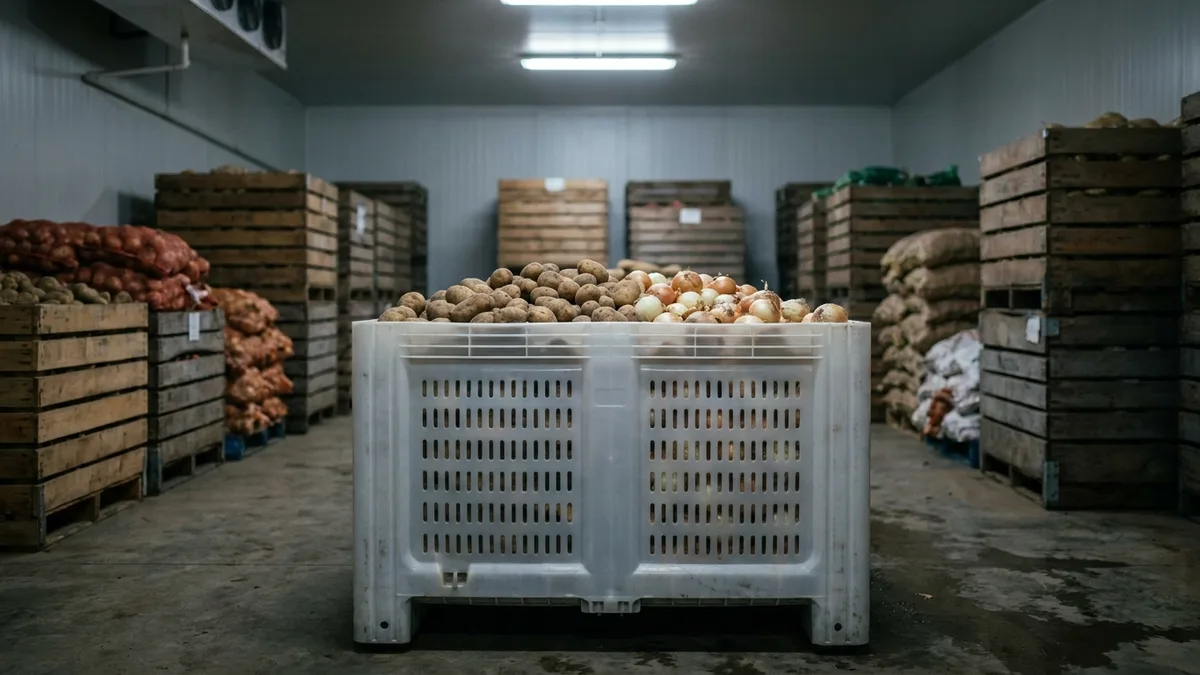
They commissioned the BPB-CUSTOM-V Folding Vented Plastic IBC — a made-to-order collapsible bulk container built in HDPE to the group's own dimensions, vent pattern and footprint. Because it is a bespoke unit, the vent layout could be specified to match the crop and the curing airflow the coolroom was designed around, and the external footprint could be set to use the rack bay pitch fully. The folding construction was the other non-negotiable: a collapsible body meant empties could be flattened for the return leg to member farms instead of riding back at full height.
Specifying a custom mould carries a tooling premium and a minimum order — here an MOQ of 80 units — so this was a considered, fleet-scale decision rather than a small top-up purchase. The group judged that the throughput and storage gains from a bin built to their line justified it.
How the rollout went
Working from the filler and rack drawings, the dimensions and vent geometry were locked in before tooling, so the first production units dropped into the line and racking as intended. Curing performance was the early proof point: with the vent pattern matched to the crop, air moved through the produce mass the way the coolroom engineers had modelled, rather than the compromised airflow a generic bin would have given.
The estimated result
For a produce business, the value shows up in two places. First, freight: collapsing the empties for the backhaul to member farms cuts empty-leg volume sharply, and we estimate an empty-return saving of an estimated 70%-plus versus carting rigid bins. Second, shrink: ventilation tuned to the crop reduces in-store spoilage, and even a few percentage points of recovered crop across a harvest can outweigh the container cost. Taken together, we estimate the custom folding vented unit recovers its tooling premium through the freight saving plus reduced store shrink across roughly a couple of harvest seasons. These are estimates framed against the product's design and the group's own infrastructure, not a guaranteed return — but for an operator that had already built the line and the racks, sizing the bin to match was the logical last piece.