
A Riverland Packer Trials Returnables on Used Crates — and Keeps Them
A Riverland citrus and stone-fruit packer in South Australia.

The operation
This is a citrus and stone-fruit packer in the Riverland of South Australia, packing seasonal fruit for market and running a small on-site workshop for their own gear. They wanted to move off single-trip cartons onto returnable crates, but — like a lot of family-scale packers — they weren't willing to tie up capital in a full fleet of brand-new crates before the format had proven itself on their fruit.
The problem with the old handling
Cartons were the recurring cost they wanted gone: bought new every season, used once, then disposed of. But the obvious fix, a new returnable-crate pool, meant a meaningful upfront spend on a packer's tight cash flow, and they had genuine questions — would a deep crate hold their fruit well, would the venting actually help, would the crates fold and stack the way they needed in their shed. They needed a low-risk way to find out.
Why this crate
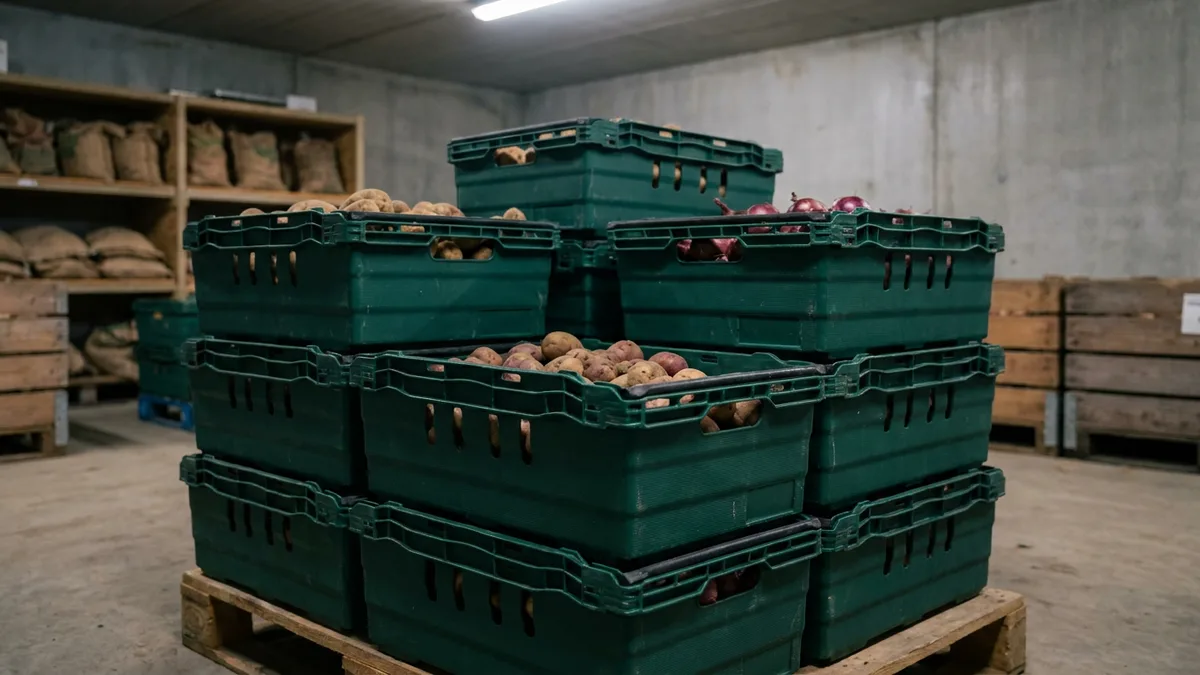
They chose the BPB-C5721UFV, a 41-litre used folding vented Australian-Standard crate. It is a 577 x 385 x 211 mm unit in polypropylene, with a deep 559 x 360 x 203 mm internal cavity, cross-stacking and stacking built in, and a folded height of just 34 mm. Crucially it is sold refurbished, at a used price point — which is exactly what let the packer trial returnables affordably instead of committing to new units.
The depth suited a strong pick load of citrus and stone fruit; the venting sheds field heat and stops the fruit sweating in transit; and being food-grade it doubles for the workshop side and parts handling without issue. The 34 mm folded height meant empties collapse almost flat for the return leg. The used condition was the enabler — same service on the fruit, a fraction of the capital.
The rollout
With a modest minimum order around 192 units, the packer brought in a working quantity of the refurbished crates and ran them through a full pack season alongside their carton flow. They confirmed the deep cavity carried a useful load without bruising, that the venting kept the fruit cool through the short cold chain, and that the crates folded and cross-stacked cleanly on the pallet. Once the format proved itself, the used crates simply stayed in service — the "trial" became the standard.
The result — estimated
The headline is capital efficiency, framed as an estimate. Buying refurbished rather than new saved an estimated 50% or more on the crate outlay versus an equivalent new fleet — the single biggest reason the packer was willing to make the switch at all. Against the cartons they displaced, we estimate the changeover cost was recovered within roughly two seasons of avoided carton purchases, after which the crates keep saving on every cycle.
The freight side adds to it: folding the empties to 34 mm for backhaul cut empty-return freight by an estimated 65% against carting rigid boxes back from market each run. And standardising on a single crate size across fruit and workshop handling trimmed the time lost to sorting mismatched boxes. None of these are guaranteed figures — they move with trip counts and the season — but the logic that won the packer over is simple: prove the returnable format on cheap used crates, recover the cost against cartons in a couple of seasons, then run them for years.