
A Barossa winery crosses food and beverage handling with a refurbished 33L folding crate
A Barossa winery running a small smallgoods kitchen alongside intake.

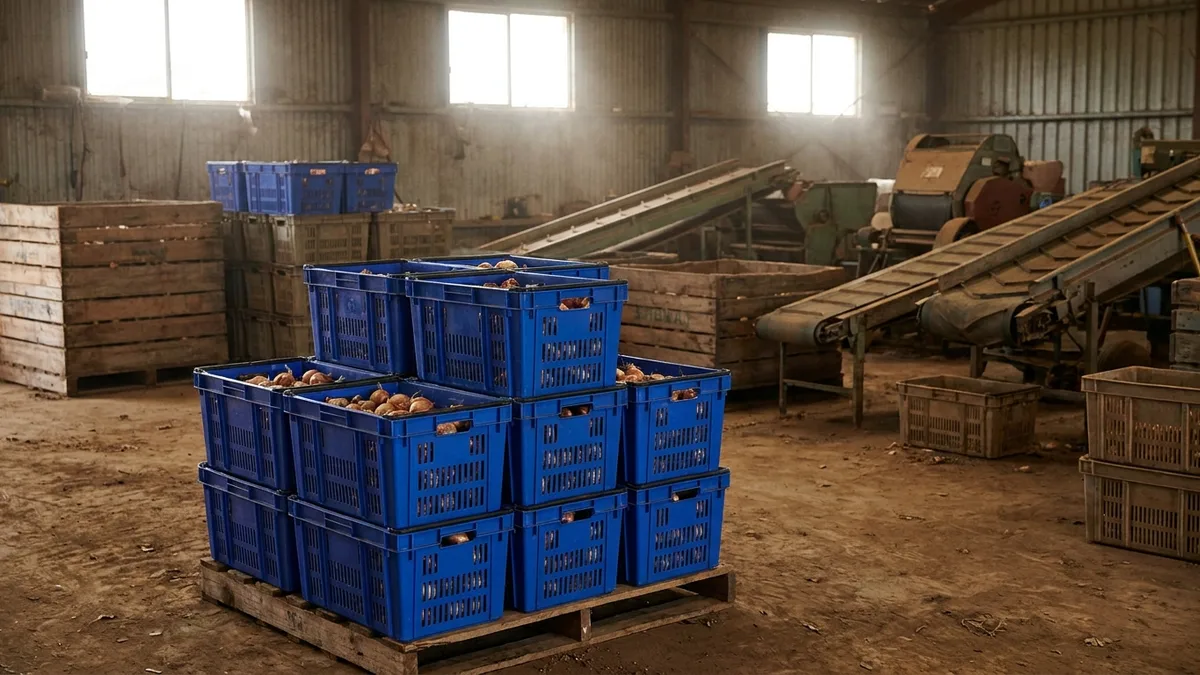
Hand-picked parcels, a meat room, and a tight changeover budget
A winery in the Barossa took in hand-picked fruit parcels at vintage and also ran a small smallgoods kitchen, which meant it needed crates that could legitimately cross food and beverage handling — deep enough for a useful pick, vented to stop fruit sweating, and food-grade for meat-room transfers. Buying a full fleet of brand-new crates to prove the format was hard to justify on a boutique budget, especially for a use that spanned two quite different parts of the operation.
Why a used 33L folding vented crate made the trial affordable
The winery chose a refurbished 577 x 385 x 173 mm folding vented crate with a 33 L capacity, bought at a used price point rather than new. The depth carries a sensible pick weight, the open venting prevents the condensation that would otherwise sweat the fruit on the way to the cellar, and the food-grade PP body is suitable for the smallgoods transfers as well — so a single crate type serves intake and kitchen alike. At a folded height of just 34 mm the empties collapse to a fraction of erected volume, which matters for a business shuttling crates between vineyard, cellar and kitchen. Buying reconditioned kept the capital outlay for the trial well down without giving up the service life of a sound plastic crate.
The rollout
Because the cost of entry was low, the winery could commit a real working pool rather than a token few, and run it across a full vintage intake and a kitchen production cycle. One standard crate size immediately simplified handling — crews were not sorting between mismatched boxes on busy intake days — and the venting kept incoming fruit in better condition during the short transfers. Folding the empties flat cut the volume being freighted back and forth between the three sites. Satisfied that the refurbished crates performed like the format they were testing, the winery kept them in rotation as the standard cross-use crate.
An estimated result, clearly hedged
The numbers here are estimates, not audited results, and they depend on intake volume, how far crates travel between sites and ongoing carton spend. With that caveat, we estimate the used buy landed at an outlay well under half the cost of equivalent new crates, which is what made committing a real pool feasible. Standardising on one crate size is estimated to have saved 1 to 2 labour hours on busy intake days previously lost to handling and de-nesting mismatched boxes, and folding the empties flat is estimated to have cut return-leg volume between vineyard, cellar and kitchen by around two-thirds versus carting rigid boxes. Against ongoing carton purchases, we estimate the changeover paid for itself within an estimated two seasons. None of these figures is an absolute price or a promised return; a winery can test them against its own intake labour, its inter-site freight and its carton bills, and the conservative read is that a low used entry cost plus simpler handling plus collapsed backhaul recovers the spend quickly.