
How a Goulburn Valley pear grower trialled returnables affordably with a used 27L folding vented crate
A Goulburn Valley (VIC) pear grower running fresh pack-out plus a juice side-line.

The operation
A Goulburn Valley pear grower in northern Victoria running two streams off the same orchard: fresh fruit packed out to market, and second-grade fruit diverted to a small juice and food-manufacturing side-line. They wanted to move to returnable crates but were not willing to sink new-crate capital into a format before proving it worked across both streams. The brief was: let us trial returnables properly, but cheaply.
The problem with the old handling
Both streams were running on single-trip cartons, with the usual penalties — recurring purchase cost, poor in-transit cooling from solid boxes, and a mix of odd box sizes that made palletising and sorting slower than it needed to be. The juice transfers in particular were a waste of good packaging, since fruit headed for pressing did not need a pristine new carton, yet that is what it was getting.
Why this product
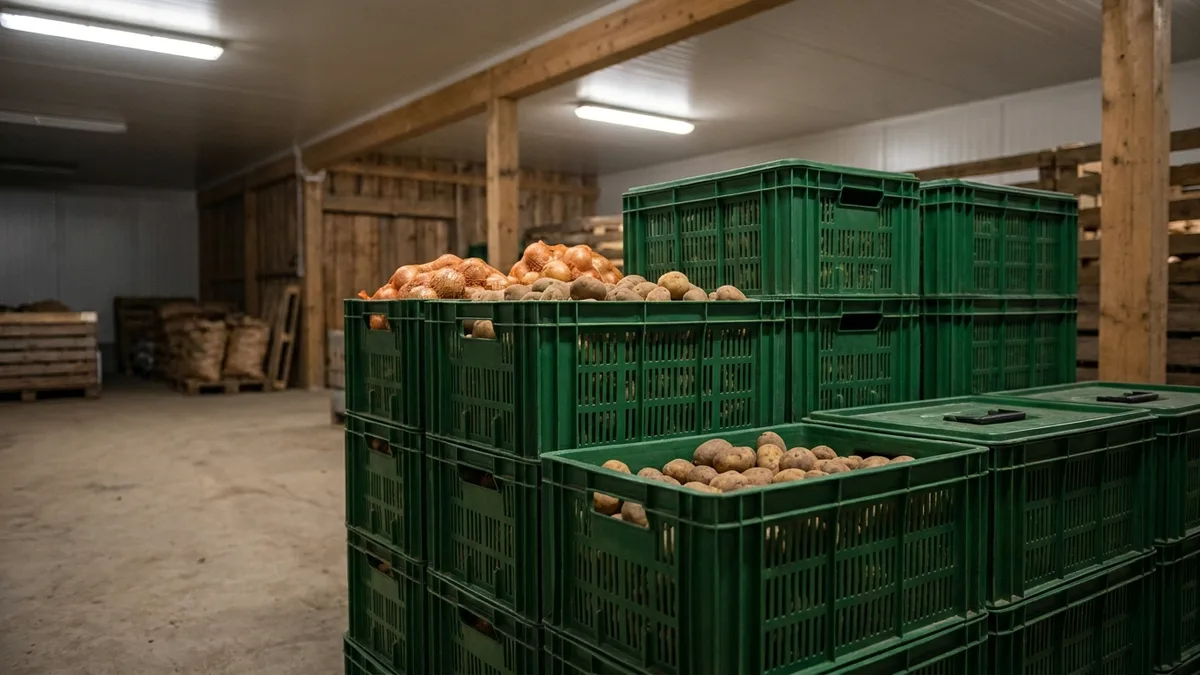
They chose the 27-litre used folding vented crate — a reconditioned, food-grade Australian-Standard crate that let them trial the returnable format at a fraction of new-crate cost. The specifications fit both streams: 577×385×143 mm external with a 559×360×135 mm internal cavity giving a useful 27 litres — a mid-depth crate that suits a decent fruit pick. The vented PP walls keep fruit cool in transit, the crate cross-stacks for stable palletising, and it folds to just 34 mm for the empty return leg. At 1.39 kg each they are light on the line. Being a defined, single standard size, the crate also tidied up the mixed-box muddle that was slowing their packing. The reconditioned condition was the whole point: it took the capital risk out of trialling returnables on a crop they were still proving the format against.
How the rollout went
Buying refurbished kept the changeover cheap enough that the trial was an easy yes. The crate handled both fresh pack-out and the juice transfers without complaint — food-grade for both, deep enough for a real pick, vented to keep fruit cool. Standardising on the single size cut the time the crew lost sorting and matching the old assortment of boxes, and on the return run the empties folded flat to 34 mm and shipped back at a fraction of erected volume before being re-erected for the next pick.
The estimated result
The grower estimates the used crates landed at well under half the cost of new equivalents, which is what made the trial viable in the first place. Against ongoing carton spend across both the fresh and juice streams, they estimate the reconditioned units paid for themselves within an estimated two seasons. On the empty-return leg, folding the crates flat is estimated to have cut backhaul freight by an estimated 60–65% versus carting rigid boxes back. And standardising on one crate size is estimated to have trimmed roughly an hour a day of mixed-box sorting at peak. All of these are estimates — they depend on crop volume, trip frequency and crate service life — but the strategic point stands: buying used let the grower prove the returnable format and capture most of its savings without tying up new-crate capital before they were sure it suited their dual-stream operation.