
A Victorian mushroom grower trims return-freight and cold-store congestion with 17 L folding vented crates
A Victorian mushroom grower running daily field-to-DC and supermarket dispatch..

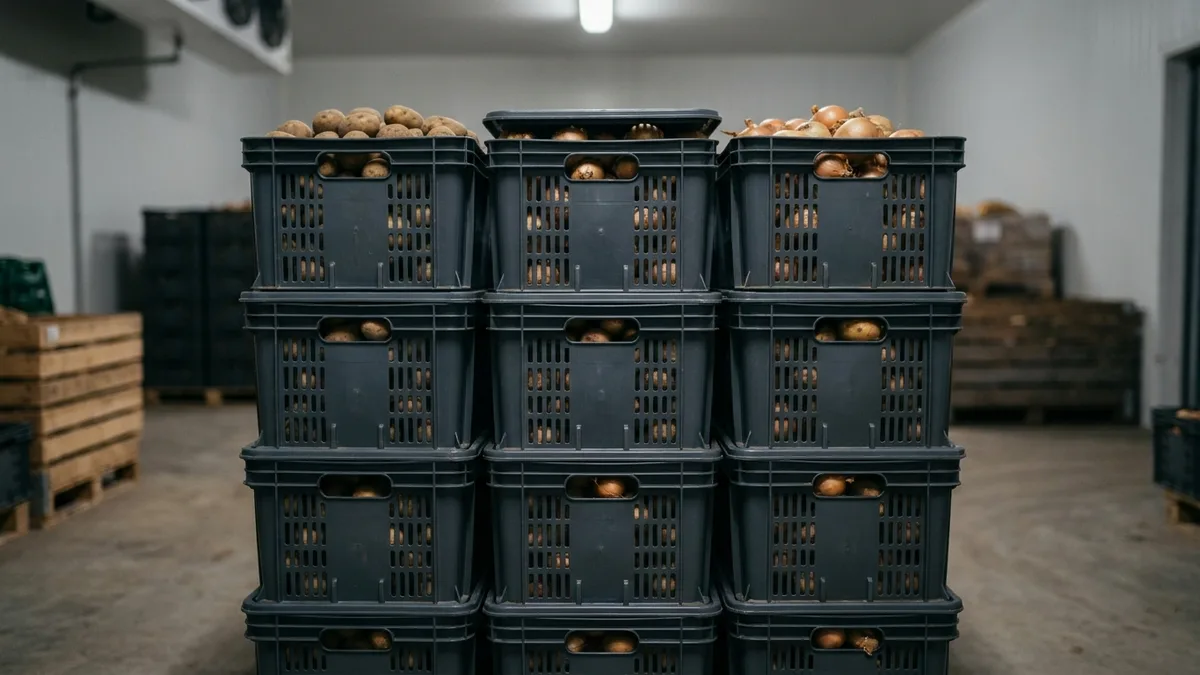
The operator and the problem
This operator is a mid-sized mushroom grower in regional Victoria, picking daily and dispatching into supermarket distribution centres across the south-east. Their handling problem was not picking, it was logistics. Mushrooms and berries are fragile, breathe heavily, and move fast through the cold chain, so the grower needed a ventilated crate that protected punnets in the cool room and on the truck. The catch was the return leg. Rigid harvest crates went out full and came back full of air, and at 577 x 385 x 95 mm each, empties were eating pallet space and return-freight dollars on every backhaul. Cool-room floor was also tight, and stacks of empty rigid crates were stealing space that should have held picked product.
Why this crate
The deciding feature was that this is a folding crate. Erected it stands 95 mm tall, but it collapses to a folded height of just 34 mm, roughly a 2.8 to 1 knock-down ratio. In plain terms, close to three folded crates occupy the stack height of one erected one, so the return leg and the empty-storage footprint shrink by about two thirds. The crate is a 17 L Australian Standard vented design with an internal 559 x 360 x 87 mm, which suits punnet layouts and lets cold air move through the load rather than around it. At 1.16 kg each it is light for pickers to handle all shift, and it is moulded in food-grade polypropylene, so it washes down and cycles back into the cool chain without absorbing moisture or odour. It is stackable and supports cross stacking, which let the grower build stable, ventilated columns on the pallet and key alternating layers for transit rigidity.
The rollout
The grower started with a single pooled run sized to the 192-unit minimum order quantity and trialled it on one packing line against the existing rigid crates. The 17 L format dropped in on the same pallet pattern, so no racking or pallet changes were needed. Pickers adapted in a shift, the wash-down crew confirmed the polypropylene cleaned up cleanly between cycles, and the dispatch team folded empties flat to 34 mm at the DC for the return run. Once the first 192 had cycled cleanly, the operator scaled the pool to cover several days of picking in circulation at once, holding folded stock as a compact buffer rather than a wall of empty rigid crates.
Industry fit
For agriculture, food distribution logistics and supermarket supply, this crate fits the exact pain points of fresh, breathing produce. The vented Australian Standard footprint is what DCs expect at intake, so it moves through grading and receiving without friction. The ventilation protects mushrooms and berries through the cool chain, the light 1.16 kg body suits high-frequency manual picking, and the fold-flat design answers the structural problem of any daily grower-to-retailer lane: empties have to travel and store somewhere. A crate that drops from 95 mm to 34 mm turns that dead leg into recoverable space.
Estimated result
On the return leg, folding to 34 mm means empties take roughly a third of the stack height of rigid crates, so the grower can plan on cutting return-freight crate volume in the order of two thirds and freeing comparable cool-room floor space. Because the crates are reusable and cross-stack on the existing pallet pattern, the changeover carried no racking cost, and a pool sized near the 192 MOQ typically pays back within about a year on saved backhaul and recovered storage alone. These figures are planning estimates only; the actual saving depends on the operator's own picking volumes, pool size, cool-room constraints and specific freight lanes.