
How a Riverina onion packer maximised curing volume per pallet position with a folding vented jumbo bin
A Riverina (NSW) onion grower-packer.

The operator
This is a sizeable onion grower-packer in the New South Wales Riverina, curing, holding and packing brown and red onions for the domestic supermarket trade and an export consolidator. Through the back half of the season the whole operation is a fight for coolroom and shed space, and every pallet position is precious. They asked us to help on two fronts at once: get more crop curing per pallet footprint, and stop their bulk bins eating storage and return-truck space when they sit empty out of season.
The problem with the old handling
Their bulk onions were curing in a mix of standard-footprint vented bins and some solid timber boxes. Two issues compounded. The standard footprints capped how much crop they could cure per pallet position, so they ran out of room at peak. And the rigid bins, once empty, occupied a full pallet footprint each in the shed and on the return truck whether they were carrying anything or not — dead volume they were effectively paying to store and freight. On a high-volume onion programme, both were a direct cost.
Why this product
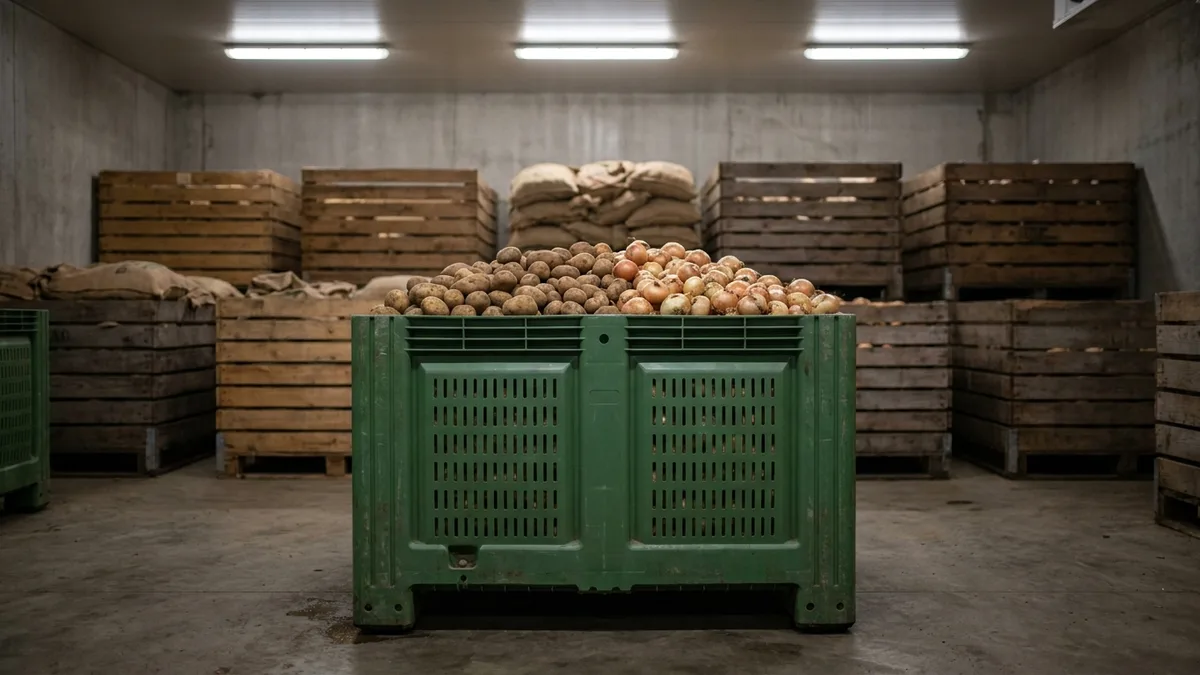
They chose the Folding Vented Jumbo Bulk Container (BPB-C1212V80): the widest vented footprint in the range at 1200 x 1200 mm, 805 mm tall, with an 880 L body moulded from food-grade HDPE, rated to 7,000 kg static and 850 kg dynamic, with 4-way entry, and folding to a 293 mm collapsed height. The wide 1200 x 1200 vented body maximises the curing crop carried per pallet position, which is exactly the room they were short of. Full-height venting lets curing and respiration heat move through the bulb mass instead of pooling, which protects condition in store. The 7,000 kg static rating supports the dense stacking a coolroom demands, and the 4-way entry speeds handling. Critically, the bin folds to 293 mm, so empties stack roughly three-to-one for off-season storage and the return leg.
The rollout
They brought the jumbos in ahead of the main harvest and used them through curing and coolroom holding, where the extra footprint immediately bought them more crop per position than the standard bins they replaced. The venting effect showed through the deep bulb mass within the first weeks of curing. At season's end the crew folded the empties flat and stacked them three-high, freeing a large block of shed space that rigid bins had been hogging. The fold is a few-seconds operation, so it added nothing meaningful to handling.
The estimated result
We frame these as estimates because shrink, fill and freight all move with season, variety and store conditions. On stored-onion shrink, venting the bulb mass through curing cuts the soft-and-sweated losses a solid bin creates — even a few percentage points recovered on a crop held for weeks recovers more value than the bins cost. On space, the wide footprint lifts curing crop per pallet position, and folding to 293 mm means roughly three collapsed bins occupy the footprint of one erected box, which we estimate strips around 65% off the volume freighted and stored as empties. Put together, we estimate the combination of lower curing shrink and an estimated 65% empty-return saving recovers the changeover within a couple of seasons, after which it keeps paying on every cycle — with an HDPE service life many times that of the timber it displaced.