
How a Pilbara resources contractor cut round-trip logistics cost with a tall folding jumbo container
A Pilbara (WA) iron-ore services contractor.

The operator
This is a contracting business servicing iron-ore operations in the Western Australian Pilbara, responsible for kitting and freighting bulky spares, fittings and consumables from a coastal supply base out to remote mine sites hundreds of kilometres inland. On long inland hauls every cubic metre of trailer space is expensive, and the contractor was losing a lot of it on the empty leg.
The problem with the previous setup
Spares were going to site in rigid crates that came back empty at full height. A rigid box does not care whether it is full of pump components or full of air — it occupies the same footprint on the return run either way. Over a Pilbara round trip that meant paying premium remote-haul freight to carry empty boxes back to the coast, and consolidating a single load often took several smaller containers, multiplying the handling at both ends. The contractor wanted one large container that carried more per move and collapsed for the costly trip home.
Why this product
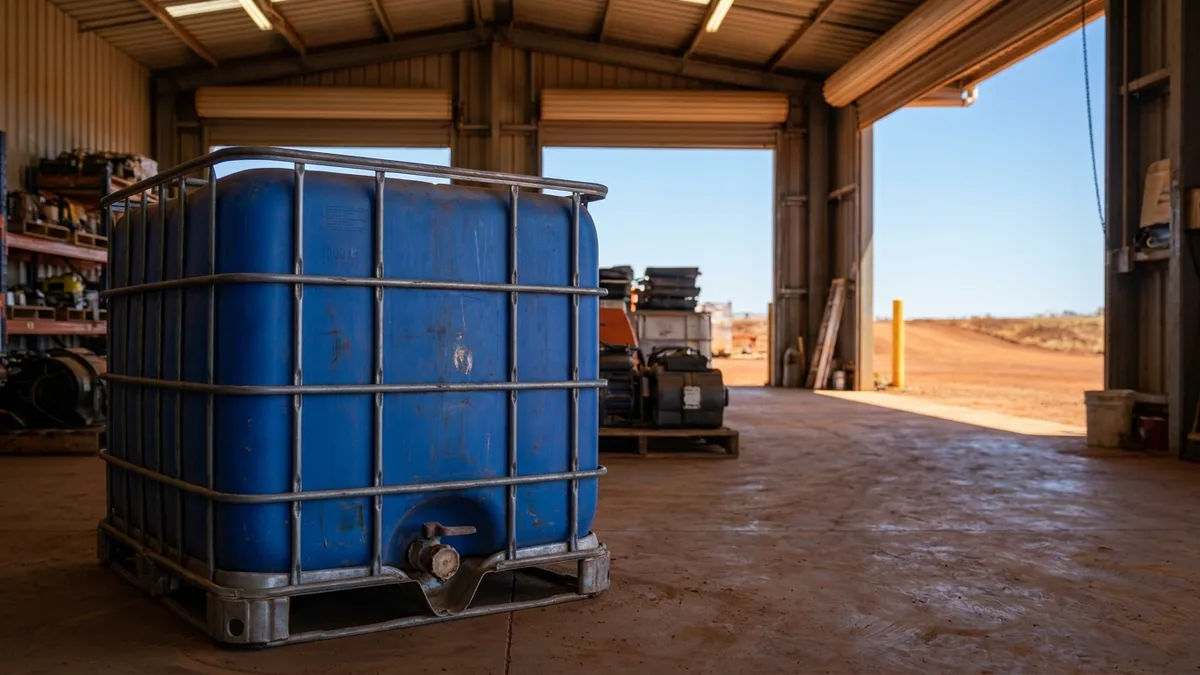
They specified the folding solid jumbo bulk container (1200×1200×978 mm, 1,080 L, HDPE, 7,000 kg static, 950 kg dynamic, 4-way entry, 61 kg). The wide 1200×1200 footprint and 1,080 L body consolidate what previously needed several smaller boxes, so fewer, larger units clear the same kit; the 7,000 kg static rating takes dense, point-loaded fittings without complaint, and 4-way entry suits handling at rough remote hardstands. The decisive feature on a remote run is the 465 mm folded height: collapsed, roughly three jumbo units stack into the space of one erected box, so the empty leg back to the coast carries flat-packed containers instead of full-height air.
The HDPE shell is also far better suited to harsh site conditions than timber crating — it does not splinter, soak up moisture, harbour termites or break down under UV and heat, so the same containers cycle for years rather than being consumed and dumped at camp.
How the rollout went
The contractor put the jumbo containers on its longest, highest-cost inland lane first, where the empty-return penalty was steepest. Kit that had been split across several boxes now consolidated into single jumbo units at the supply base; on site, crews unpacked and folded the boxes flat to 465 mm, and the collapsed units rode back to the coast three-to-one. Once the saving was clear on the marquee lane, the format was extended to the contractor’s other remote runs.
The result (estimated)
The gains stack on two axes. Consolidating into fewer, taller 1,080 L containers cut the number of moves per kit, and folding to 465 mm collapsed the empty-return profile so back-haul carried flat-packed boxes rather than full-height ones. Combined, we estimate the change trimmed round-trip logistics cost by an estimated 20–30% on the long-haul site runs where it was deployed — a figure driven by fewer container moves outbound and a far smaller empty leg home. On top of that, the durable HDPE shell outlasts the timber crating it replaced many times over in Pilbara conditions, removing the recurring spend on one-trip boxes consumed at remote camps. All numbers are estimates dependent on lane length, load density and trip frequency, and are not a price quote.