
Maximum Curing Volume That Still Folds Flat: A Tasmanian Veg Packer's Switch
A Tasmanian vegetable packer in the north-west.

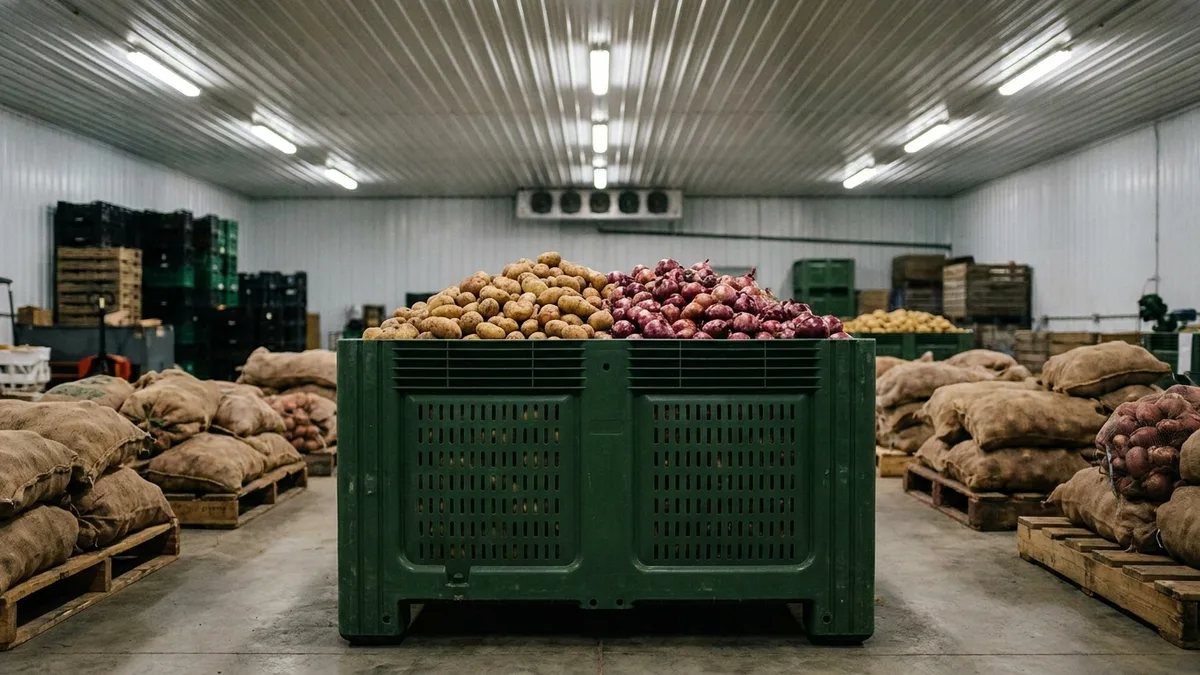
The operation
This is a vegetable packer in north-west Tasmania handling large volumes of stored produce on an ISO (1200 x 1000) pallet system. Their model depends on holding crop through a controlled-storage window and then grading and dispatching steadily, so they need bins that both cure well and don't choke their store and transport when empty between crops.
The problem with the old handling
The packer wanted two things that usually pull against each other: maximum curing volume per pallet footprint, and bins that fold flat for winter storage. Their existing rigid bins gave them volume but were a storage nightmare out of season — a yard full of empty rigid boxes at full height eats shed space and costs money to freight when they're cycled between sites. Where they had tried shallower folding bins, they lost crop-per-footprint and ended up handling more bins to store the same tonnage.
Why this container
They chose the BPB-C1210V97, a 905-litre ISO (1200 x 1000) folding vented bulk container. It stands 978 mm tall with an internal 1120 x 920 x 833 mm cavity, is moulded from food-grade HDPE, and is rated to 7,000 kg static and 850 kg dynamic with 4-way entry. The combination is the point: it is one of the tallest vented bins on the ISO footprint, so it holds substantially more crop per pallet position than a standard-height box, while still collapsing to a 465 mm folded height for the off-season.
Full-height venting supports drying and curing through the deeper crop mass — important, because a taller bin only works if air can still reach the middle. The 7,000 kg static rating lets the packer stack bins densely in store, and the ISO footprint matches their existing racking and handling exactly. The HDPE build gives the usual hygiene and longevity advantages over timber, with a service life many times longer.
The rollout
With a minimum order around 48 units, the packer brought these in as a store-and-dispatch standard for their highest-volume lines. They ran a first season filling the taller bins and confirming the crop cured evenly to the top of the deeper cavity — the venting did its job — then folded the whole fleet flat at the end of the season to validate the storage saving. Drivers liked that the 4-way entry let them work the taller, heavier bins from any approach in a tight store.
The result — estimated
The gain here is a combined one, and we frame it as an estimate. By holding more crop per footprint in the taller body, the packer moves the same tonnage in fewer bins and fewer pallet positions, which cuts handling moves and store aisles. By folding those same bins to 465 mm out of season, the empty-storage and empty-return profile collapses dramatically against a rigid box of equivalent capacity. Taken together — bigger fill on the way in, folding empty on the way out — we estimate the packer trimmed combined storage and freight cost by an estimated 20-30% versus shorter rigid bins.
The HDPE longevity is the quieter win: against timber on a two-to-three-season renewal cycle, these bins should give a decade-plus, so the bin-replacement budget shrinks over time as well. As always the percentage depends on how the store and the freight lanes are run, but the structural advantage — high cure volume that still folds — is exactly what the packer couldn't get from either rigid bins or shallow folders before.