
A WA gold operation folded its remote-site freight bill with a tall ISO bulk container
A Western Australian Goldfields gold operation supplying a remote processing site.

Empty boxes coming back at full height
A gold operation in the Western Australian Goldfields ran a constant supply line of reagents, grinding media and dense consumables out to a processing site several hundred kilometres up the highway. For years the freight moved in rigid timber crates and solid plastic boxes that did one job well on the way out and then became dead weight on the way back. Empties returned at full height, so a return trailer that could in theory have carried saleable backloads instead carried air boxed inside rigid walls. On long Goldfields hauls, where every return-leg kilometre is paid for whether the box is full or empty, that wasted cube was a recurring, measurable cost. The site team also disliked how timber crating coped with the conditions — red dust, heat and rough handling at a remote laydown were slowly destroying it.
Why the 905L folding solid ISO container
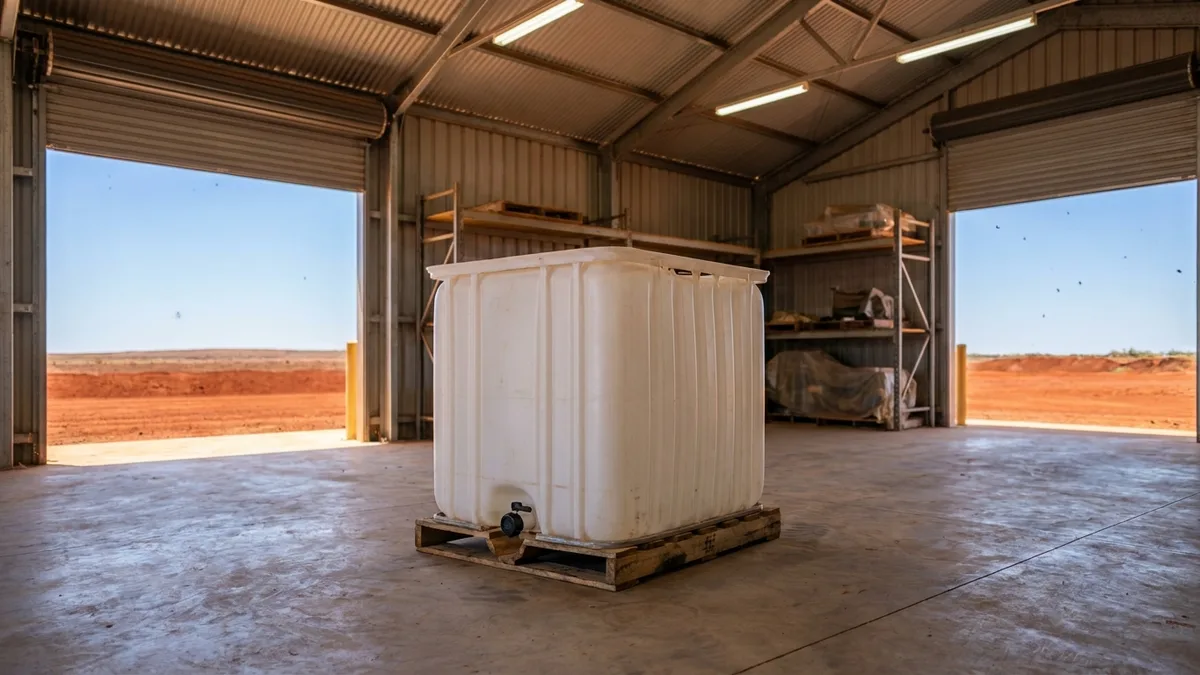
The operation standardised on the Folding Solid ISO Bulk Container (BPB-C1210S97). On the 1200x1000 mm ISO footprint it matched the pallet system already in use at both the warehouse and the site, so it dropped into existing racking and onto existing trailers without rework. Three specs did the heavy lifting. First, capacity: at 905 L of usable volume on a tall 978 mm body, one container consolidated a serious amount of consumable per move. Second, strength: a 7000 kg static rating meant the boxes could be stacked deep in store under dense, point-loaded freight without complaint, and an 850 kg dynamic rating let a forklift lift a loaded unit cleanly. Third, and the whole point of the exercise, the container folds to just 465 mm. A collapsed unit is less than half the height of an erected one, so empties stack roughly three-to-one for the run home. The solid HDPE shell also shrugged off the dust and heat that had been chewing through timber.
Rollout on the supply line
The changeover was run as a closed loop rather than a one-way ship. Containers were filled at the warehouse, railed and trucked to site erected, emptied into the plant, then folded flat by the site crew and palletised for the next backload. Because the box collapses without tools and re-erects in seconds, the extra step added almost nothing to handling time at either end. The crews quickly settled into the rhythm of folding empties as they cleared them, and the laydown stopped accumulating the broken timber it used to.
The estimated result
The dominant saving is on the empty return leg. With collapsed units stacking around three-to-one against erected boxes, we estimate the fold removed on the order of 65% of the empty-return freight on this lane — the single biggest line item the project set out to attack. Consolidating consumables into fewer, taller 905 L containers is also estimated to have trimmed the number of outbound moves needed to shift a given tonnage, compounding the saving on both legs. Over the asset's life the HDPE shell is expected to far outlast the timber crating it replaced in a hot, dusty, high-handling environment, converting a recurring crate-replacement cost into a one-off reusable-fleet purchase. As always these are planning estimates rather than a guaranteed outcome: the realised saving depends on haul distance, how reliably empties are folded and returned, and the backload opportunities freed up on the return trailer. For a remote Goldfields operation, though, the logic is hard to argue with — you are no longer paying line-haul rates to truck empty air back across the state.