
How a WA gold operation cut empty-return freight on remote reagents with a folding solid ISO bulk container
A Western Australian (Goldfields) gold operation.

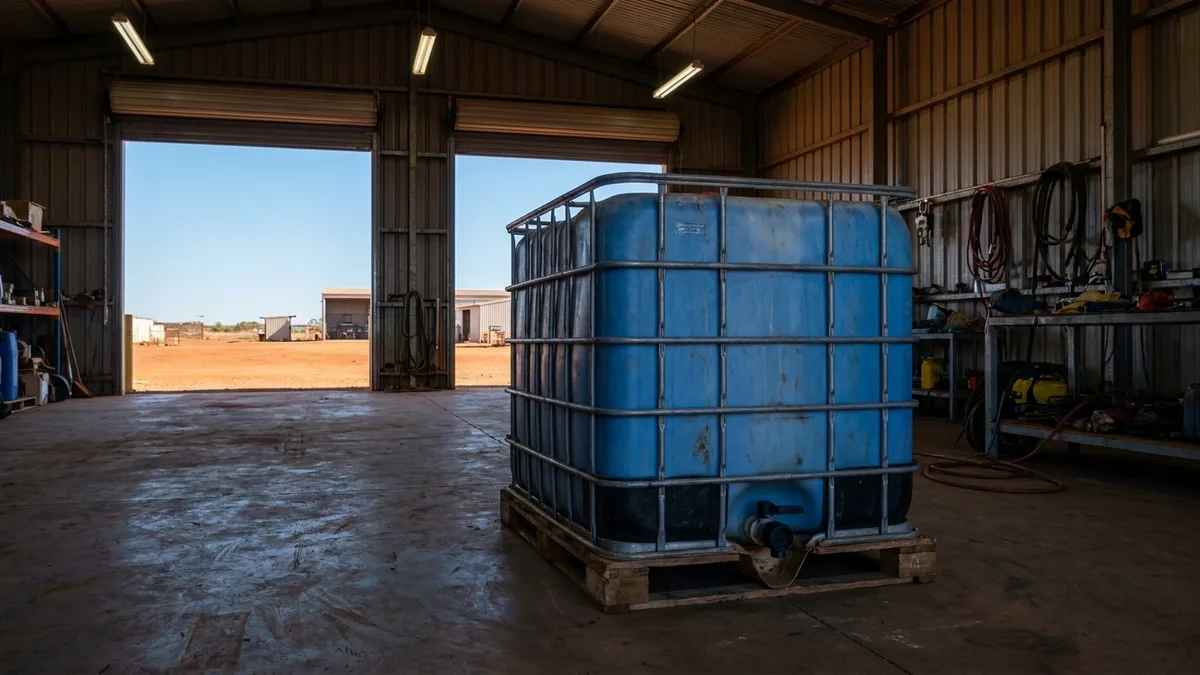
The operator
This is a gold operation in Western Australia's Goldfields, running a remote processing site supplied over long haul distances from a regional base. Its procurement and warehouse team trucks a steady flow of reagents and dense consumables out to the site, and like every remote operation, the cost of the empty return leg is a constant drag on the logistics budget. They asked us to look at the containers carrying that freight, because the units were coming back at full height and quietly burning truck space on every run across the Goldfields.
The problem with the old handling
Reagents and heavy consumables were going out in rigid boxes and crates. A rigid box has a brutal flaw on a remote lane: it occupies exactly the same truck volume empty as it does full, so the backhaul was carrying air at full freight cost. Worse, a good proportion of the timber crating did not survive the haul roads and the exposed site conditions, so units were being damaged, condemned and disposed of at a remote camp with limited waste handling. They needed a container strong enough for dense, point-loaded freight but able to collapse for the return.
Why this product
They standardised on the Folding Solid ISO Bulk Container (BPB-C1210S80): a 1200 x 1000 mm ISO footprint, 805 mm tall, with a 720 L body moulded from HDPE, rated to 7,000 kg static and 750 kg dynamic, with 4-way forklift entry and a choice of two-skid, three-skid or four-foot base. The spec is built for exactly this job. The 7,000 kg static rating takes heavy, point-loaded reagent drums and dense consumables that would deflect a lighter deck, and the ISO footprint drops onto their existing racking and transport. The decisive feature is the fold: it collapses to a 293 mm folded height, so empties stack roughly three-to-one for the back-haul. And because it is a tough HDPE reusable rather than one-trip timber, it ends the cycle of disposing of damaged crating at a remote camp with nowhere to put it.
The rollout
They trialled a batch on their highest-frequency supply lane first — the run carrying routine reagents and consumables out to the plant. Bins were loaded at the regional base, run to site, unloaded into the store, then folded flat and consolidated for the return run. The crew found the fold-down quick enough that it added nothing meaningful to turnaround, and the HDPE shell took the haul-road and site punishment that had been writing off the timber. Once the loop was proven on one lane, they scaled it across other site runs.
The estimated result
These figures are estimates, framed deliberately, because freight savings depend on lane length, fill pattern and how disciplined the return cycle is. The largest lever is the fold: collapsing to 293 mm means roughly three empties travel in the footprint of one erected box, which on a long Goldfields haul we estimate strips on the order of 65% off the empty-return freight versus shipping rigid crating back at full height. On top of that, replacing one-trip timber with a durable HDPE reusable removes the recurring crate-disposal problem at the remote camp and the cost of constantly re-buying crating. We estimate the container's cost is recovered comfortably within the first year on a steady supply lane, after which the empty-return saving accrues on every round trip while the HDPE shell keeps performing in conditions that quietly destroy timber.