
How a Goldfields reagent store gained a rack position with a high-rated medium-duty ISO pallet
A Western Australian Goldfields mining reagent and consumables store.

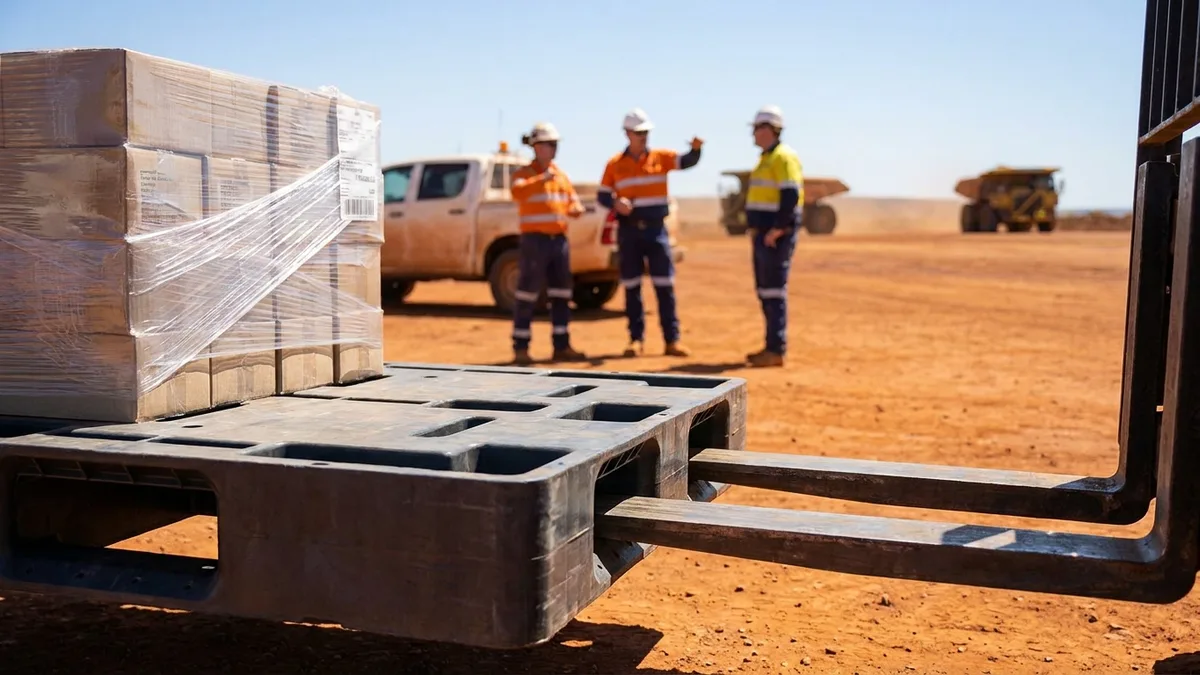
The operation
A mining reagent and consumables store in the Western Australian Goldfields, racking drummed chemicals and dense consumables in a hot, chemically aggressive environment hundreds of kilometres from the nearest major centre. Two demands defined the pallet they needed. First, a high racking rating: drummed reagent is dense, and the more weight a pallet can safely carry in the rack — the AS 4084 racking figure, not the static headline — the more product fits per bay. Second, durability: a chemical store in Goldfields heat is no place for timber, which rots, gets attacked by termites, and absorbs spills.
The problem with the old handling
Timber pallets were on a constant replacement cycle in that environment — the heat and chemical exposure degraded them, termites and rot took their toll, and absorbent timber was the wrong surface for a spill-prone reagent area. They also had a storage-density problem: a low-rated pallet limits how much dense drummed product can safely go into each rack bay, which in a remote store where every pallet position is hard-won is a real constraint on capacity.
Why this product
They standardised on the medium-duty ISO plastic pallet with a cruciform full-perimeter base, chosen specifically for its high racking figure. The specifications: 1200×1000×165 mm on the ISO footprint, 18.5 kg, HDPE, rated to 5,000 kg static, 1,250 kg dynamic, and a published racking rating of 1,100 kg — one of the higher rack figures in the range. Loaded to that published 1,100 kg figure, the pallet keeps the racking compliant under AS 4084 even under dense drum loads, and because that rack rating is high, more reagent can sit safely in each bay. The full-perimeter base spreads the load across the beams for stable, compliant racking. The non-absorbent HDPE deck is the other half of the fit: it shrugs off the termites, rot and heat that were destroying timber, and it does not soak up chemical spills the way timber did.
How the rollout went
The pallets went into the reagent racking with loads planned against the 1,100 kg racking figure, keeping the dense drum storage demonstrably within AS 4084. The high rack rating let the store plan more product per bay than a lower-rated pallet would have allowed safely. The HDPE deck stopped the termite and rot write-offs that came with timber, and the non-absorbent surface suited the spill-prone chemical area far better than the boards it replaced.
The estimated result
The store estimates that the higher rack rating let them safely store an estimated extra pallet position per bay versus the lower-rated pallet they would otherwise have used — a meaningful capacity gain in a remote store where every position counts. Framed as an estimate because the exact gain depends on bay geometry and product density, the mechanism is concrete: a 1,100 kg AS 4084 racking rating simply permits denser, compliant storage. On top of the capacity benefit, moving to a non-absorbent HDPE deck ended the timber rot, termite damage and chemical-soak replacement cycle that a hot Goldfields reagent store inflicts on timber. The combination — more compliant rack capacity per bay plus the end of the timber replacement treadmill — is exactly what a dense-load chemical store in a harsh, remote environment needs, with the key discipline being to load to the published 1,100 kg racking figure rather than the 5,000 kg static headline.