
A Lockyer Valley grower trials returnable crates affordably with a 50 L used vented box
A Lockyer Valley mixed-vegetable grower packing carrots and parsnips.

The operator and the problem
A Lockyer Valley mixed-vegetable grower wanted to shift carrots and parsnips off single-trip cartons and onto returnable crates, but was not willing to tie up new-crate capital before the format had proved itself on their crop and their handling. Root vegetables come off the wash line wet and need to shed moisture before the coolroom; cartons sagged when damp, crushed under stacking, and went one-way to landfill at the receiving end. The grower had no easy way to test whether a deep returnable would actually pay on a washed, heavy crop without committing to a full new fleet first, and on tight produce margins a wrong call on packaging capital hurts.
Why this crate
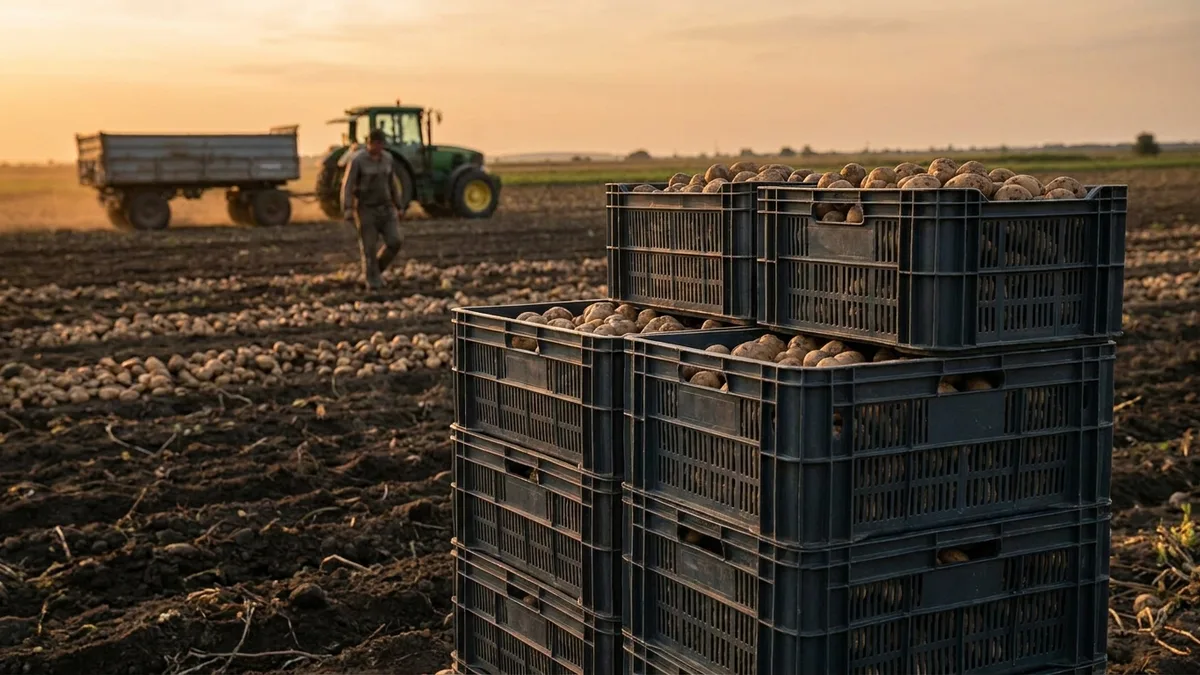
They trialled the BPB-6424U, a 50 L used vented plastic crate on the 600 x 400 mm Australian-Standard footprint at 240 mm high with a 565 x 365 x 220 mm internal cavity, moulded in HDPE. The depth suits root veg, the open venting helps shed wash moisture and keeps air moving through the load before and during cold storage, and the crate is rated stackable so full units build into stable, palletisable stacks. The deciding factor was condition and price: as a refurbished unit it carries effectively the same food-grade HDPE service life as new stock on a washed crop, but at a fraction of the new-crate outlay, which let the grower prove the returnable model without the capital risk. HDPE also stands up to repeated wash-down where cardboard never could.
The rollout
The used crates went straight into the wash-and-pack flow on the carrot and parsnip lines. Standardising on a single 50 L size meant the pick-to-pack handling stopped juggling assorted carton dimensions, the vented walls let the washed crop drain and dry instead of sweating in a closed box, and the crates stacked full on pallets for dispatch and returned into the loop afterwards. Running refurbished units first meant the trial cost little and could be scaled up only once the numbers held, and because the 600 x 400 size is an industry standard the crates dropped straight onto existing pallets and into the cold chain without any other change.
Why used made sense
For a grower de-risking a move to returnables, second-hand crates are the ideal proving ground: the same dimensions, the same venting and effectively the same service life as new on a washed crop, at roughly half the cost or less. That lets the format be tested at real scale on real product, with the option to expand the pool on the strength of measured results rather than a leap of faith.
Estimated result
We estimate the refurbished crates cost well under half of new while delivering effectively the same service life on a washed crop, so the trial recovered its outlay quickly against avoided carton purchases. Standardising on one crate size also cut pick-to-pack handling by an estimated 1-2 hours on a busy harvest day by removing the sorting and re-boxing that mixed cartons forced, and venting that lets the crop dry before the coolroom reduces the store losses damp cardboard had been hiding. These are season-dependent estimates rather than a quoted saving, but buying used let the grower de-risk the switch to returnables entirely: prove the format cheaply on carrots and parsnips first, then expand the pool on the strength of real results.