
A light nestable ISO export pallet carries a real load to remote Goldfields camps
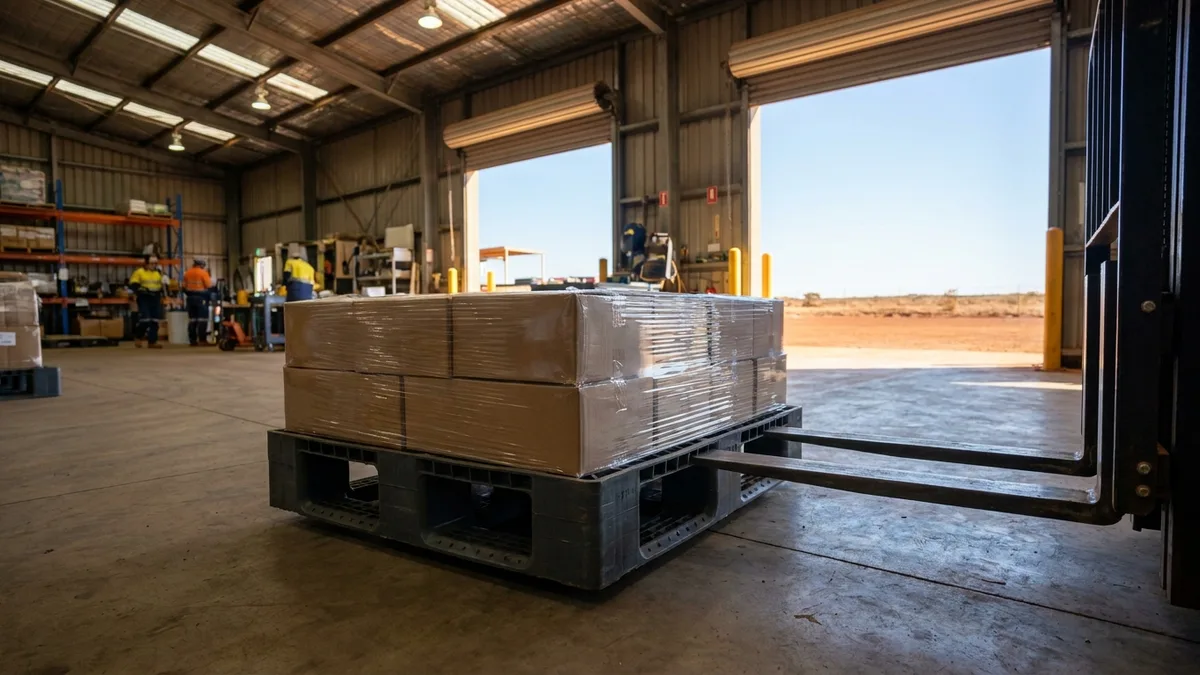
A Goldfields equipment supplier sending sealed spares to remote mine camps.

The operator and the problem
A Goldfields equipment supplier sending sealed spares and consumables to remote mine camps needed a pallet that was light enough not to penalise freight on long hauls, yet strong enough to carry a useful stacked load and survive arrival at a rough bush camp. Timber boards were heavy, one-trip, and frequently binned on arrival because returning them across that distance made no sense, and on any export movement the timber dragged ISPM-15 treatment into the equation. Splintered timber arriving at camp was also a manual-handling complaint, the last thing wanted at a remote site with limited people and no easy way to replace damaged stock.
Why this product
They standardised on the BPB-120, a light-weight nestable ISO-standard export pallet on the 1200 x 1000 mm footprint at 140 mm high, moulded in HDPE at just 7.5 kg. The balance is the point: a 3,200 kg static rating supports stacked storage and a 900 kg dynamic rating handles the forklift work, all at a low tare that keeps freight cost down over distance. It runs 4-way entry on snap-on skids, so a damaged foot can be swapped rather than scrapping the whole pallet, and it nests for compact storage and return. Being plastic, it is exempt from ISPM-15 treatment on any export leg, so consignments that crossed a border did not need fumigation or a certificate. For a supplier sending sealed goods to camp, that combination of low weight, real strength and treatment-free export was hard to match in timber.
The rollout
The pallets went under sealed spares bound for camp. The low tare kept the freight bill in check on the long Goldfields runs, the 3,200 kg static rating let the supplier stack stock confidently in the warehouse before dispatch, and where pallets did come back they nested down to a fraction of flat-timber cube for an efficient return. The snap-on skids meant the occasional knock at a rough camp did not write off a unit, a damaged skid was simply replaced and the pallet stayed in service, which suited an operation where sending a repair part back and forth is impractical.
Why a light export pallet fit
Remote-site supply rewards a pallet that is cheap to freight, strong enough to stack and tough enough to outlast a single trip, because the cost and difficulty of moving anything to and from camp is the dominant constraint. A 7.5 kg deck rated to 3,200 kg static, with replaceable skids and ISPM-15-exempt plastic construction, hits all three, where timber forced a trade-off on at least one.
Estimated result
We estimate the nestable empties cut return-freight cube by an estimated 40% against flat timber, and the durable HDPE deck outlasted the one-trip timber pallets that had simply been binned on arrival at camp. Avoiding ISPM-15 on any export movement removed treatment cost and lead time from those consignments as well, and replaceable skids extended the working life of each unit rather than scrapping it on a single damaged foot. These are estimates that depend on how many pallets cycle back, lane length and load profile rather than a quoted saving, but matching a low 7.5 kg tare to a genuine 3,200 kg static rating gave the supplier a pallet that was cheap to freight, strong enough to stack, and tough enough to last where timber did not.