
A Goldfields Parts Store Stocks Up on Used Square Pallets That Beat the Termites
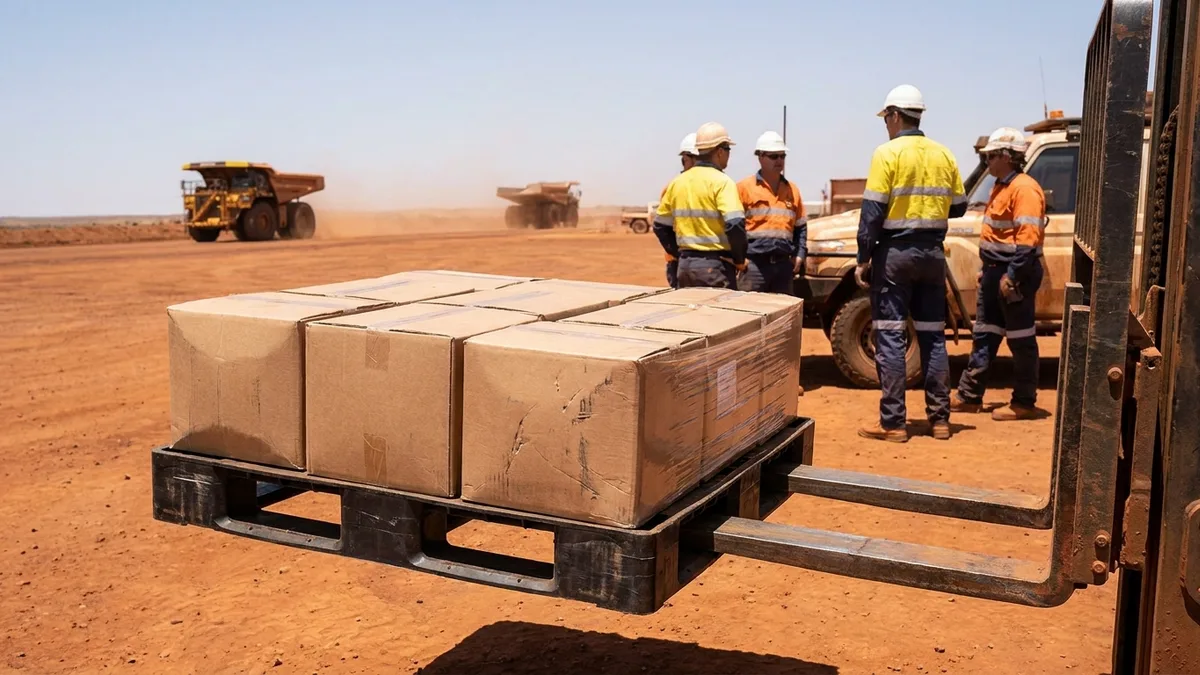
A Goldfields mining parts store in Western Australia.

The operation
This is a mining parts and consumables store in the Western Australian Goldfields, holding general stacked stock in a hot, humid, termite-active shed. The store sits a long way from anywhere, so when stock needs a pallet it needs one now, not on a multi-week lead time. Their need was unglamorous and common: square medium-duty pallets, in a hurry, at low cost, for routine non-critical storage — without the rot and insect damage that had been steadily destroying their timber. They had no appetite for a capital case or a procurement cycle every time a storage bay filled up; they wanted serviceable decks they could order against petty spend and put straight to work.
The problem with the old handling
Two things were hurting the store. Timber pallets in a humid, termite-prone shed were a write-off cycle — boards got eaten and rotted, and there was a permanent line in the budget for replacing them. And when they needed extra pallets quickly for a general storage need, new units were more cost and lead time than a non-critical job could justify. They wanted cheap, durable, square pallets they could get fast.
Why this pallet
They took the BPB-110UM, a second-hand medium-duty 1100 x 1100 export pallet supplied in mixed makes across PC, PO and HDPE. Both nestable and stackable, with a low minimum order around 30 units, it is sold as reconditioned stock at a used price point. The logic was straightforward. For routine, non-critical stacked storage, a reconditioned plastic deck performs reliably without the cost of new tooling — so buying used was the right call for the job rather than a compromise.
And critically, being plastic, the pallets shrug off the termites and humidity that were destroying timber in the shed. So the cheaper pallets are also the longer-lasting ones in this specific environment — the used plastic outlasts the new timber it replaced. The square 1100 x 1100 footprint also suits export movements and, being plastic, sidesteps ISPM-15 if any of the stock is later shipped.
The rollout
The low minimum order and the used price point made this an easy, low-risk buy — the store could bring in a batch quickly for a general storage need without a capital case. They put the reconditioned pallets straight into routine stacked storage, confirmed the mixed-make decks carried their loads reliably, and watched them survive the shed conditions that had been eating timber.
The result — estimated
The cost saving is the headline, framed as an estimate. Buying second-hand rather than new cut the pallet outlay by an estimated 40-60% — the decisive factor for non-critical storage that didn't warrant new-unit spend. For a routine job, the reconditioned decks performed just as well as new would have.
The durability gain is the one that keeps paying. Because the plastic pallets shrug off the termites and humidity that were destroying timber, the cheaper used units also lasted longer than the boards they replaced — so the store both spent less upfront and stopped feeding the annual timber-pallet write-off cycle. We frame the saving as an estimate because used pricing and condition vary with available stock — but the combination is hard to argue with: square medium-duty pallets, fast, at roughly half the cost of new, that outlast timber in a shed that eats timber.