
How a Goldfields contractor stood up racking fast on a budget with second-hand heavy-duty pallets
A Goldfields (WA) mining contractor.

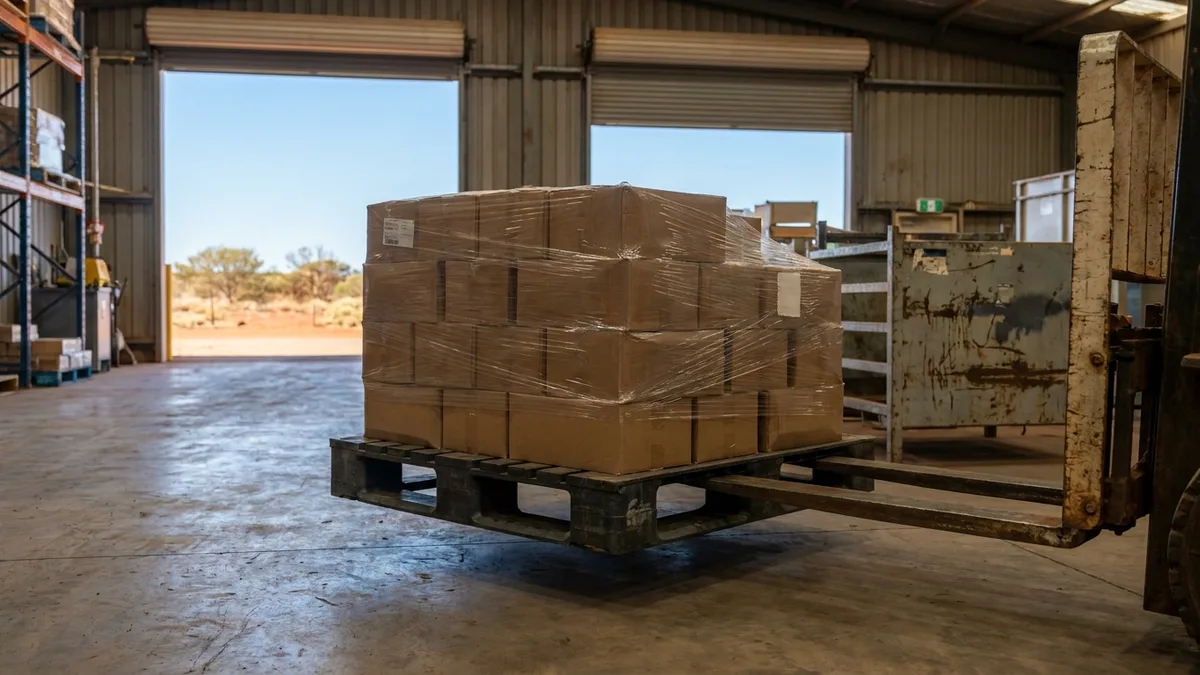
The operator
This is a mining contractor in the Western Australian Goldfields that needed rackable pallets in a hurry for a short-term storage surge — a finite project with a defined end date, not a permanent fleet expansion. Buying new heavy-duty pallets for a job that would wrap up in months was hard to justify, but the racking still had to be filled with compliant, durable decks.
The problem with the previous setup
The contractor faced a classic capacity-spike dilemma. New pallets carry full price and lead time, which is poor value for temporary use; timber spares, the usual cheap fallback, rot and harbour termites in a humid Goldfields store and would also trip ISPM-15 treatment if any stock later went for export. They needed racking-capable pallets quickly, cheaply, and without inheriting the rot, termite and biosecurity problems that timber would bring.
Why this product
They took second-hand heavy-duty 1100×1100 mm export pallets (mixed makes in PC/PO/HDPE, rackable and stackable, reconditioned). For a finite project, used plastic decks carry racked loads reliably without the cost of new tooling, and the square 1100×1100 export footprint suited both the racking and any later outbound movement. Being plastic, the pallets also sidestep the rot and termite damage that timber suffers in a humid shed, and they are exempt from ISPM-15 — so when some stock was later exported, the units cleared biosecurity without heat treatment or fumigation, unlike the timber alternative.
As reconditioned heavy-duty units, they delivered the racking capability the project needed at a used price point, with the durability of plastic rather than the disposability of cheap timber. Because the bundle was a mix of makes in heavy-duty PC, PO and HDPE, the contractor took care to load racked positions conservatively to the most cautious rating in the mix rather than assuming a single uniform capacity — a sensible discipline with any second-hand mixed-make pallet going into beam racking.
How the rollout went
The contractor brought the used pallets straight into the surge racking. The reconditioned decks loaded and racked like new for the duration of the project, handling the storage spike without incident, and because they were plastic the humid store did not rot or infest them as it would have timber spares. When the surge passed the pallets simply went back into general rotation rather than being scrapped, and when a portion of stock later shipped overseas, the same pallets went out without any ISPM-15 treatment step.
The result (estimated)
Buying used rather than new was the decisive saving. We estimate the second-hand route cut the pallet outlay by an estimated 40–60% against new heavy-duty units — an easy call for capacity needed only for a finite project. Beyond price, the plastic decks avoided the rot and termite write-offs that timber spares would have suffered in the humid store, and their ISPM-15 exemption removed treatment cost and delay on the stock that was later exported. As a guide, used pallet condition and pricing vary with availability, so these are estimates rather than a price quote, and exact savings depend on the makes supplied and the length of the project.